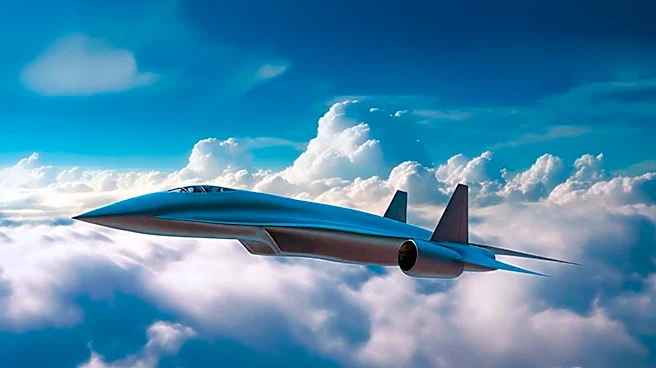






The Lockheed SR-71 Blackbird stands as a testament to aerospace engineering, a long-range, high-altitude strategic reconnaissance aircraft that pushed the boundaries of flight. Developed in the 1960s, this iconic aircraft was designed to fly faster and higher than any other air-breathing manned aircraft, setting numerous speed and altitude records that remain unbroken. Its unique capabilities allowed it to evade threats not through stealth alone,
but by simply outrunning and outclimbing them, making it a formidable asset during its operational life.
Unmatched Performance and Evasive Tactics
The SR-71 was engineered to operate at extraordinary speeds and altitudes, typically cruising at Mach 3.2 and 85,000 feet (26,000 meters). This performance profile was its primary defense mechanism. If a surface-to-air missile launch was detected, the standard evasive action was not to maneuver, but to accelerate and outpace the missile. The aircraft was faster than the Soviet Union's fastest interceptor, the Mikoyan-Gurevich MiG-25, which also could not reach the SR-71's operational altitude. This combination of speed and altitude meant that by the time a SAM site could acquire and track the SR-71, it was often too late to launch a missile, or the SR-71 would be out of range before the missile could catch up. No SR-71 was ever shot down during its operational history.
Beyond its raw speed, the SR-71 also employed electronic countermeasures (ECMs) to further enhance its survivability. These included various warning and active electronic systems designed to confuse enemy tracking. A reconnaissance systems officer (RSO) would use jammers to disrupt missile sites, but would switch them off once a missile launch was confirmed to prevent the missile from homing in on the jammer's signal. The aircraft's design also incorporated early stealth technology, with a shape designed to reflect radar energy away from its source and special radar-absorbing materials in its skin. Despite a wing area of about 1,800 square feet, its radar cross-section was significantly reduced to around 110 square feet.
Advanced Materials and Engineering Challenges
Achieving such extreme performance required groundbreaking innovations in materials science and engineering. Titanium constituted 85% of the SR-71's structure, with polymer composite materials making up much of the remainder. Working with titanium presented significant challenges, as it is rigid and difficult to machine. Lockheed had to develop new fabrication methods, including using distilled water for washing welded titanium to prevent corrosion from chlorine in tap water, and avoiding cadmium-plated tools for the same reason. Metallurgical contamination was a persistent issue, with 80% of delivered titanium sometimes being rejected.
The aircraft's skin was designed to fit loosely on the ground, with proper alignment achieved only as the airframe heated up during high-speed flight due to thermal expansion. This characteristic also meant the aircraft leaked JP-7 fuel on the ground before takeoff, as the fuel tanks, which formed part of the outer skin, only sealed effectively when the skin warmed up. The unique JP-7 fuel itself was difficult to ignite, requiring triethylborane (TEB) to be injected for engine start-up, producing a characteristic green flame. This fuel also served as a heat sink, cooling the pilot and electronics.
Specialized Systems and Crew Environment
The SR-71's operational environment demanded specialized systems for its two-person crew: a pilot and a reconnaissance systems officer (RSO). Flying at 80,000 feet meant standard oxygen masks were insufficient, leading to the development of specialized protective pressurized suits by the David Clark Company. The cockpit itself required a heavy-duty cooling system, as external surfaces could reach over 500°F (260°C) and the windshield interior 250°F (120°C) during Mach 3.2 cruising. An air conditioner used a heat exchanger to dump heat into the fuel before combustion, also cooling the front landing gear bay.
Navigation for long reconnaissance flights relied on an Astro-Inertial Navigation System (ANS) that tracked stars through a quartz glass window on the upper fuselage. This system, with its "blue light" star tracker, could see stars day and night and contained an ephemeris of 56 to 61 stars for celestial navigation. The ANS provided altitude and position data, controlled cameras and sensors, and allowed for automatic navigation to preset points, demonstrating remarkable accuracy with drift limited to 1,000 feet off the direction of travel at Mach 3. The SR-71's tires, made by B.F. Goodrich, contained aluminum and were nitrogen-inflated, costing $2,300 each and typically needing replacement within 20 missions. Landing at over 170 knots required a drag parachute to reduce landing roll and minimize wear on brakes and tires.
Operational Logistics and Records
Refueling the SR-71 was a complex operation, requiring specialized KC-135Q tankers equipped with modified high-speed booms and separate fuel systems for JP-4 (for the tanker) and JP-7 (for the Blackbird). The SR-71 would take off with a partial fuel load to reduce stress on its brakes and tires, then refuel shortly after takeoff. A common misconception was that this was due to fuel leaks, but while the aircraft did leak on the ground until its skin warmed and sealed, the amount was not enough to necessitate immediate refueling. The partial load was a deliberate operational procedure. The SR-71 set the record for the quickest flight between London and New York in 1974, completing it in 1 hour, 54 minutes, and 56 seconds, a record it still holds as of 2026. It also became the fastest air-breathing manned aircraft in 1976, surpassing its predecessor, the Lockheed YF-12, and continues to hold this world record. These achievements underscore the Blackbird's enduring legacy as a marvel of aviation technology.