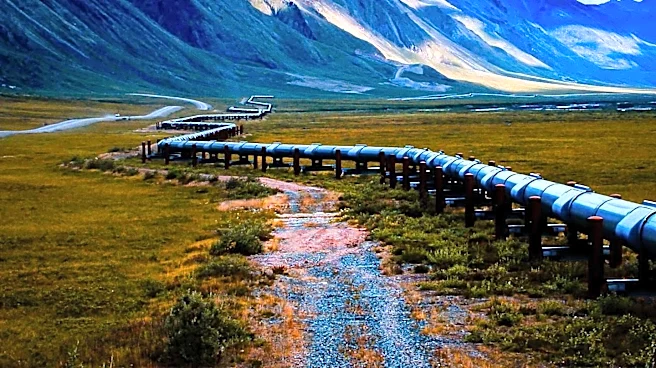







The Trans-Alaska Pipeline Authorization Act of 1973 stands as a pivotal piece of United States federal legislation. Signed into law by President Richard Nixon on November 16, 1973, this act was crucial in enabling the construction of an oil pipeline designed to transport crude oil from Alaska's North Slope to Port Valdez. Its passage was not merely about authorizing a construction project; it was a direct response to pressing national energy concerns
and a decisive move to overcome significant legal and environmental hurdles that had stalled the pipeline's development.
The act's primary function was to halt all legal challenges that had been mounted against the pipeline's construction. These challenges were predominantly filed by environmental activists who raised concerns about the potential ecological impact of such a massive undertaking in a pristine wilderness. By signing this legislation, President Nixon effectively cleared the path for the project to proceed, underscoring a national priority for energy independence and resource development.
Political Support and Legislative Journey
The legislative journey of the Trans-Alaska Pipeline Authorization Act began with its introduction in the Senate as S. 1081 on March 1, 1973, by Senator Henry M. Jackson of Washington. Although Alaska's congressmen—Don Young, Ted Stevens, and Mike Gravel—were strong proponents of the act, their lack of major seniority meant that a more established figure like Senator Jackson took the lead in its introduction. This highlights the broad political backing the project garnered, extending beyond just the state directly impacted.
Following its introduction, the bill underwent consideration by the Senate Interior and Insular Affairs Committee. It successfully passed the Senate on July 17, 1973, with a vote of 77-20, demonstrating significant bipartisan support. The House of Representatives then passed the bill on August 2, 1973, with a vote of 356-60, in lieu of its own version, H.R. 9130. The joint conference committee reported on the bill on November 7, 1973, and it was subsequently agreed to by the House on November 12, 1973 (361-14), and by the Senate on November 13, 1973 (80-5), before reaching the President's desk.
Impact of the 1973 Oil Crisis
The timing of the act's passage was deeply intertwined with the unfolding energy crisis of 1973. On October 17, 1973, just weeks before the act was signed, the Organization of Arab Petroleum Exporting Countries (OAPEC) announced an oil embargo against the United States. This embargo was a retaliatory measure for U.S. support of Israel during the Yom Kippur War. Given that the United States imported approximately 35 percent of its oil from foreign sources, the embargo had a profound and immediate effect on the nation.
The consequences were severe: gasoline prices surged, shortages became widespread, and rationing was seriously considered. This crisis created an urgent demand among most Americans for a solution to the nation's energy vulnerability. In this context, President Nixon actively lobbied for the Trans-Alaska Pipeline, presenting it as a vital component of the answer to the country's energy woes. The crisis undoubtedly accelerated the legislative process and solidified political will for the pipeline's construction, transforming it from a regional project into a national imperative.
Regulatory Exemptions and Long-Term Vision
Notably, the Trans-Alaska Pipeline Authorization Act, in accordance with President Nixon's request, contained no amendments that would allow federal and state agencies, such as the Environmental Protection Agency, the Alaska Department of Natural Resources, or the Alaska Department of Fish and Game, to regulate the construction of the pipeline. This provision was a deliberate measure to streamline the project and prevent further delays from regulatory oversight, reflecting the urgency of the energy situation at the time.
The act, also known by short titles such as the Mineral Leasing Act of 1920 Amendments and the Federal Lands Right-of-Way Act, amended section 28 of the Mineral Leasing Act of 1920. Its long title, "An Act to amend section 28 of the Mineral Leasing Act of 1920, and to authorize a trans-Alaska oil pipeline, and for other purposes," clearly outlined its dual purpose: to update existing mineral leasing laws and to specifically authorize the Alaskan pipeline. This legislative action not only facilitated the immediate construction of a critical energy infrastructure but also set a precedent for balancing environmental concerns with national energy security in a period of significant geopolitical tension.