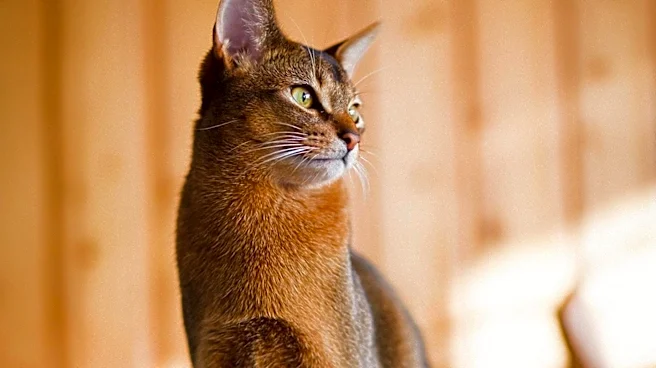









The Abyssinian cat, often affectionately called an Aby, is a breed renowned for its elegant appearance and vibrant personality. Characterized by a distinctive "ticked" tabby coat and a lean, muscular build, Abyssinians possess a unique charm. Beyond their striking looks, these cats are known for their active and social nature, making them engaging companions. However, prospective owners should also be aware of certain genetic health conditions that
are more prevalent in the breed, ensuring they can provide the best possible care for these beautiful felines.
Physical Characteristics and Distinctive Features
Abyssinians are medium to large-sized cats, typically weighing between 8 to 12 pounds (3.6–5.4 kg) and standing 8 to 10 inches (20–25 cm) tall. They are described as lithe, fine-boned, and muscular, contributing to their graceful silhouette. The head is moderately wedge-shaped, with a slight break at the muzzle, and the nose and chin ideally form a straight vertical line when viewed in profile. Their alert, relatively large pointed ears add to their wildcat-like appearance. Almond-shaped eyes, which can be gold, green, hazel, or copper depending on the coat color, are another striking feature. Abyssinians have long legs in proportion to their body, ending in small oval paws, and a long, tapering tail.
Kittens are born with darker coats that gradually lighten over several months as they mature. The adult coat is short, ideally fine, dense, close-lying, and silky to the touch, rather than soft. The hallmark of the breed is the "ticked" or agouti effect, a variant of the tabby pattern, which should be uniform over the body. Each individual hair has a light base with three or four bands of additional color, growing darker towards the tip. While the ridge of the spine, tail, back of the hind legs, and paw pads are always noticeably darker, the base color should be as clear as possible, with extensive gray intermingling considered a serious fault. A common but minimal tendency to white on the chin is also observed, and the typical tabby M-shaped marking is often found on the forehead.
Coat Colors and Genetic Variations
The original color standard for the Abyssinian is a warm, deep reddish-brown base with black ticking, known as "usual" in Europe, "tawny" in Oceania, and "ruddy" in the U.S. This color exhibits a high degree of rufism. A unique mutation of this pattern led to cinnamon (also called "sorrel" or "red"), which features a lighter coppery base with cinnamon-brown ticking. Other color variants have been introduced through outcrossing with breeds like the Burmese and other shorthaired cats. These include blue, characterized by a warm beige base, and fawn, which has a softer creamy peach base.
Less common colors like chocolate and lilac are recognized by some registries and have even achieved full champion status with others, though not universally accepted. Most registries also acknowledge the silver series, where the base coat is a pure silvery-white with eumelanistic-colored ticking. Various other color combinations are permitted, including the