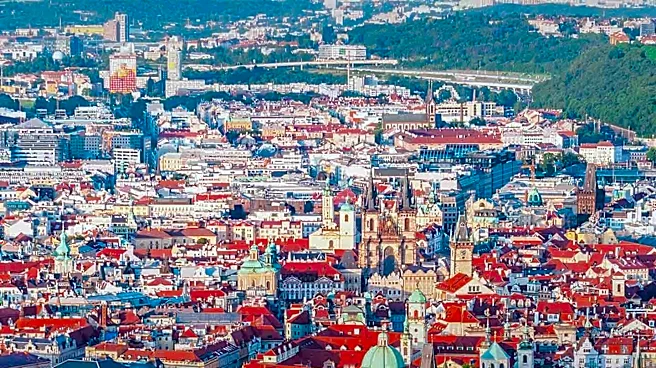




Prague, the capital and largest city of the Czech Republic, is a place where centuries of history are visibly etched into its architecture and urban fabric. Situated on the meandering Vltava River, the city has evolved from a collection of early settlements into a major Central European metropolis. Its strategic location and the river's influence have played pivotal roles in shaping its development, from its medieval origins as a trading hub to its status
as a modern capital city, rich in cultural heritage and historical significance.
Early Foundations and Medieval Growth
Prague's origins can be traced back to around the 9th century, with early settlements forming around a spacious marketplace on the bank of the Vltava River. Historical records from as early as 1100 AD indicate that this marketplace was a vibrant center, hosting weekly markets every Saturday and serving as a gathering point for large military assemblies. The prosperity generated by trade allowed the local merchants to accumulate wealth, laying the groundwork for the city's future.This economic growth led to a significant transformation when King Wenceslaus I of Bohemia granted the area the privileges of a township, officially forming the Town of Prague. During this early period, the city was well-fortified, protected by approximately 13 gates and a substantial moat, which provided strong defensive capabilities against external threats. These early structures and the burgeoning trade established Prague as an important regional center.
The Golden Age Under Charles IV
The mid-14th century marked a period of rapid growth and increased importance for the Old Town of Prague. The city flourished due to advancements in trade and craftsmanship, solidifying its position as one of Central Europe's most significant metropolises. This era of prosperity reached its zenith when Bohemian King Charles IV became the Roman Emperor in 1355, drawing the attention of all medieval Europe to Prague, which served as the residence of the head of the Holy Roman Empire.Under Charles IV's rule, significant urban and institutional developments took place. In 1338, the councilors of the Old Town acquired a patrician house and transformed it into the Old Town Hall, which still stands today. The original town hall was later expanded with a mighty square stone tower, completed in 1364, becoming the tallest in the city and symbolizing the power and pride of the town council. Charles IV also founded the University of Prague in 1348, with its main seat in Carolinum located in the Old Town, and commenced the construction of a new bridge over the Vltava in 1357, connecting the Old Town with the Lesser Town.
Urban Expansion and Reformation
Charles IV's vision extended beyond the existing city limits. In the 14th century, he ordered the building of the New Town, an extension that significantly expanded Prague's urban footprint. Following this expansion, the original moat and wall that had defended the Old Town were dismantled, reflecting a period of relative peace and continued growth. This expansion integrated new areas into the city, further enhancing its status and capacity.The late 14th century also saw the construction of the Bethlehem Chapel in the Old Town in 1391, specifically for sermons delivered in Czech. This chapel became a crucial site for the Bohemian Reformation and the Hussite movement, with the church reformer Jan Hus preaching there between 1402 and 1413. These religious and social movements further cemented Prague's role as a center of intellectual and spiritual ferment in Central Europe.
Challenges and Unification
Prague's history was not without its challenges. In 1689, a major conflagration, known as the French fire, caused extensive damage to a large portion of the Old Town, including the Jewish Town. Despite such setbacks, the city continued to endure and rebuild. A significant administrative change occurred in 1784 when the four distinct towns of Prague were formally united into the Royal Capital City of Prague, establishing a common administration for the entire urban area.This unification marked a new chapter in Prague's governance and development, consolidating its various historical districts under a single authority. The city's resilience, its strategic location on the Vltava, and its rich historical layers, from medieval markets to imperial residences and centers of religious reform, have all contributed to making Prague the unique and enduring capital it is today. Its historic center was recognized for its outstanding universal value when it was inscribed on the UNESCO World Heritage List in 1992, a testament to its long and complex history.