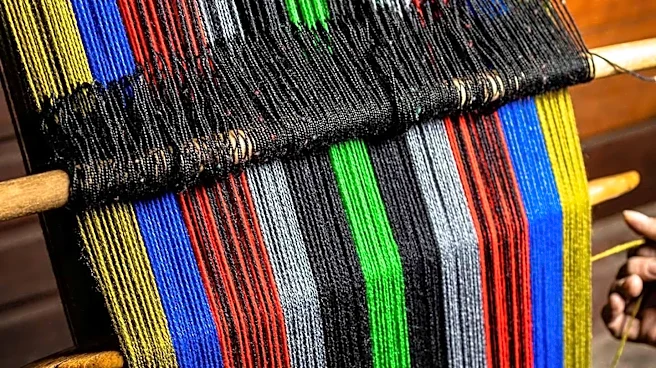









Tapestry stands as a unique form of textile art, traditionally crafted by hand on a loom. Unlike other woven textiles that often focus on patterns, tapestry is primarily used to create intricate images. This art form is characterized by its relative fragility and the demanding nature of its creation, leading most historical pieces to be designed for vertical display on walls or, less commonly, for horizontal placement over furniture. The technical
definition of tapestry centers on it being a weft-faced weaving, meaning that all the warp threads are completely hidden by the weft threads in the finished piece, a distinct feature compared to many other woven textiles where both warp and weft may be visible.
Technical Foundations of Tapestry Weaving
The creation of a tapestry involves specific weaving techniques that distinguish it from other textile arts. In tapestry weaving, the weft yarns are typically discontinuous; the artisan interlaces each colored weft thread back and forth within its own small pattern area. This method allows for the formation of a design by working weft threads of different colors over specific portions of the warp. Various loom designs can be employed for tapestry production, including upright or "high-warp" looms, where the tapestry is stretched vertically in front of the weaver, and horizontal "low-warp" looms. While low-warp looms were common in large medieval and Renaissance workshops, they later became more frequently used for smaller pieces.
The weaver consistently works on the back of the piece. To guide their work, they normally follow a full-size drawn or painted cartoon, or sometimes even another tapestry. Depending on the setup, this guide might be a mirror image of the final tapestry. The cartoon itself was generally developed from a smaller modello. In "industrial" workshops, particularly from the late Middle Ages onward, a professional artist would create this modello, often having minimal further involvement in the actual weaving process. The cartoon would then be traced onto the warp lines by the weaver and positioned where it remained visible, sometimes through a mirror, when hanging behind the weaver. For low-warp looms, the cartoon was typically cut into strips and placed beneath the weaving, allowing the weaver to see it through the "web" of threads. The Raphael Cartoons, rare surviving examples, were prepared in this manner.
Materials and Craftsmanship in Historical Tapestries
Historically, the materials used in tapestry varied, influencing both the quality and cost of the final product. In European "industrial" tapestries, the warp threads were usually wool. However, in more artisanal settings and older pieces, linen was frequently utilized. The weft threads were predominantly wool, but more expensive tapestries incorporated silk, silver, or gold thread. For instance, some renowned designs, such as the Sistine Chapel tapestries and the "Story of Abraham" set, likely first made for King Henry VIII, exist in versions both with and without precious metals. The inclusion of silk could quadruple the cost, while adding gold thread could increase it enormously, potentially making a tapestry fifty times more expensive than one made solely with wool.
Weavers were typically male, largely due to the physically demanding nature of the work, whereas spinning the threads was usually a task performed by women. Beyond the design and materials, the quality of tapestries was also determined by the tightness of the weaving. A modern metric for this is the number of warp threads per centimeter. It is estimated that a single weaver could produce about one square yard of medium-quality tapestry in a month, but only half that amount for the finest quality pieces.
The Multifaceted Functions of Tapestries
The widespread appeal of decorative tapestries can be partly attributed to their portability, a characteristic that led architect Le Corbusier to famously refer to them as "nomadic murals." The fully hand-woven tapestry form was particularly well-suited for creating new figurative designs, and the looms used could be significantly larger than those for other textiles. Kings and noblemen frequently transported tapestries between their various residences. Many royal households maintained "wardrobe" departments, complete with dedicated buildings, for the care, repair, and movement of these valuable textiles, which were folded into large canvas bags and transported on carts.
In religious settings, tapestries were displayed during special occasions. They also served a practical purpose in palaces and castles, draped on walls to provide insulation during the colder winter months, in addition to their decorative function. For grand ceremonial processions, such as coronations, royal entries, and weddings, tapestries were sometimes displayed outdoors. The largest and most exquisite tapestries, intended for more public areas within palaces, were typically shown only on special occasions to minimize wear and fading. Smaller, more personal rooms, however, were likely adorned with tapestries permanently. Many smaller pieces were crafted as covers for furniture or cushions, or as curtains and bed hangings. When tapestries, or the style in general, became unfashionable, especially for patrons outside the elite, older pieces were often cut up and repurposed for these functions. Bags and even clothing were other common re-uses. The Beauvais Manufactory, for example, specialized in furniture upholstery, which allowed it to survive after the French Revolution when this became its primary market. Tapestries containing precious metal threads faced a different fate; they might be burned to recover the metal, as Charles V's soldiers did to some Sistine Chapel tapestries, and the French Directory government did in the 1790s to much of the royal collection from the Renaissance. In the Middle Ages and Renaissance, a rich tapestry panel featuring symbolic emblems, mottoes, or coats of arms, known as a baldachin, canopy of state, or cloth of state, was hung behind and above a throne as a powerful symbol of authority. The seat beneath such a canopy was typically elevated on a dais. By the 17th century, as paintings gained prominence as significant works of art, tapestries in palaces were moved less frequently and began to be seen as more or less permanent fixtures for specific rooms. It was during this period that many old tapestries were cut to fit around doors and windows, and they often suffered the indignity of having paintings hung directly over them. Some new tapestries were even designed to fit specific rooms; for instance, the design of the Gobelins set from Croome Court, now in New York, featured a large field with an ornamental design that could be easily adjusted in size to suit a customer's room dimensions.
Global Traditions and Modern Interpretations
While European tapestries are generally made to be viewed from only one side, often with a plain lining on the back, other traditions, such as Chinese kesi and those from pre-Columbian Peru, create tapestries designed to be seen from both sides. Chinese kesi is a tapestry weave, typically using silk on a smaller scale compared to European wall-hangings, with court clothing being a primary application. Kesi pieces often feature a very high density of knots, with a top-quality gown potentially requiring as much work as a much larger European tapestry. Initially, kesi was used for small pieces, often decorated with animals, birds, flowers, or dragons for imperial garments. Under the Ming dynasty, it was also used to replicate paintings. The "Story of Troy" is a notable and unusual set of seven large tapestry hangings made in China in the 1620s for the Portuguese governor of Macao, blending Western and Chinese styles. Most of these hangings are embroidery, but the faces and flesh parts of the figures are appliquéd painted silk satin pieces, reflecting a Chinese technique often used for Buddhist banners and larger thangka forms. Kilims and Navajo rugs also represent types of tapestry work, though their designs are mostly limited to geometrical patterns, similar to other rug weaving techniques.
In contemporary times, the field of tapestry has seen a significant shift, with the artist often also being the weaver. This trend emerged in France during the 1950s, spearheaded by Jean Lurçat, a "cartoonist" for the Aubusson tapestry studios. He revitalized the medium by simplifying color selection to streamline production and by organizing a series of Biennial exhibits in Lausanne, Switzerland. The Polish work submitted to the first Biennale in 1962 was particularly innovative. With traditional workshops in Poland having collapsed due to the war and art supplies being scarce, many Polish artists, who had learned weaving in art school, began creating highly individualistic works using unconventional materials like jute and sisal. These Biennales fostered a global interest in exploring innovative constructions from a wide array of fibers. In the pre-war United States, while many weavers existed, there was no sustained system of tapestry workshops, leading American weavers to be largely self-taught and to both design and weave their art. The Lausanne exhibitions inspired US artists and others worldwide with the Polish trend toward experimental forms. Throughout the 1970s, nearly all weavers explored various techniques and materials in vogue at the time. This movement contributed to the newly recognized field of art weaving, termed "contemporary tapestry," offering the freedom to work with texture, diverse materials, and individual design. By the 1980s, the stability inherent in weft-faced tapestry weaving became another recognized benefit. Artists choosing tapestry as their medium developed a broad spectrum of personal expression, styles, and subject matter, fueled by an international movement to revive and renew tapestry traditions globally. Competing for commissions and expanding exhibition venues were crucial in how artists defined and achieved their goals. Much of the impetus in the 1980s for working in this more traditional process came from the Bay Area in Northern California, where Mark Adams and Hal Painter were influential tapestry artists. Early in the 1980s, many artists sought greater professionalism, often traveling to attend rare educational programs offered by new ateliers, such as the San Francisco Tapestry Workshop, or distant institutions. This phenomenon occurred in Europe, Australia, and North America. Juried tapestry exhibitions began to emerge by 1986, largely due to the American Tapestry Alliance (ATA), founded in 1982, which organized biennial juried exhibitions. These biennials, planned to coincide with the Handweavers Guild of America's "Convergence" conferences, significantly increased awareness among like-minded artists. Regional groups formed to produce exhibits and share information. The desire for greater international interaction led to the formation of the International Tapestry Network (ITNET) after an international tapestry symposium in Melbourne, Australia, in 1988, aiming to connect American tapestry artists with the burgeoning international community. Magazines were discontinued in 1997 as digital communication became a more effective tool for interaction. As the world entered the digital age, tapestry artists globally continue to share and inspire each other's work.
By the new millennium, however, challenges emerged within the field. Many universities that once had strong weaving components in their art departments, such as San Francisco State University, no longer offered handweaving as an option, shifting their focus to computerized equipment. A primary reason for discontinuing the practice was that only one student could use the equipment for the duration of a project, whereas in most media, like painting or ceramics, easels or potter's wheels could be used by several students in a day. Simultaneously, "fiber art" became one of the most popular mediums in art programs, with young artists interested in exploring a wider range of processes for creating art through materials classified as fiber. This shift toward multimedia and sculptural forms, coupled with a desire for quicker production, prompted contemporary tapestry artists, both within and outside academic institutions, to consider how to maintain visibility for their art form. Susan Iverson, a professor at Virginia Commonwealth University, explains her attraction to tapestry: "I came to tapestry after several years of exploring complex weaves. I became enamored with tapestry because of its simplicity — its straightforward qualities. It allowed me to investigate form or image or texture, and it had the structural integrity to hold its own form. I loved the substantial quality of a tapestry woven with heavy threads—its object quality." Joan Baxter, another prominent artist, states: "My passion for tapestry arrived suddenly on the first day of my introduction to it in my first year at ECA [Edinburgh College of Art.] I don't remember ever having consciously thought about tapestry before that day but I somehow knew that eventually I'd be really good at this. From that day I have been able to plough a straight path deeper and deeper into tapestry, through my studies in Scotland and Poland, my 8 years as a studio weaver in England and Australia and since 1987 as an independent tapestry artist. The demanding creative ethos of the tapestry department gave me the confidence, motivation and self-discipline I needed to move out into the world as a professional tapestry weaver and artist. What was most inspiring for me as a young student was that my tutors in the department were all practising, exhibiting artists engaging positively with what was then a cutting edge international Fibre Art movement." Archie Brennan, a weaver for over six decades, notes tapestry's historical sophistication: "500 years ago it was already extremely sophisticated in its development-- aesthetically, technically and in diversity of purpose. Today, its lack of a defined purpose, its rarity, gives me an opportunity to seek new roles, to extend its historic language and, above all, to dominate my compulsive, creative drive. In 1967, I made a formal decision to step away from the burgeoning and exciting fiber arts movement and to refocus on woven tapestry's long-established graphic pictorial role."