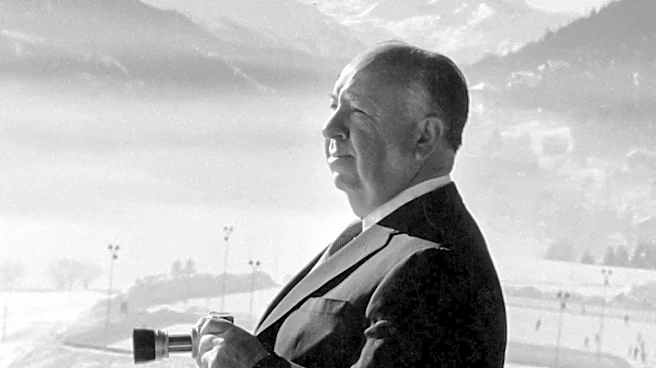






"Alfred Hitchcock Presents," an American television anthology series, left an indelible mark on popular culture during its original run from 1955 to 1965 and continues to resonate decades later. Created, hosted, and produced by the master of suspense himself, Alfred Hitchcock, the series became synonymous with mystery, thrillers, and dramas. Its unique presentation, particularly the iconic title sequence and Hitchcock's personal involvement, cemented
its place in television history and popular imagination, making it much more than just a collection of stories.
The Iconic Title Sequence and Theme Music
One of the most recognizable elements of "Alfred Hitchcock Presents" is its distinctive title sequence. The opening begins with a camera fading in on a simple line-drawing caricature of Hitchcock's rotund profile, a drawing that Hitchcock himself created. This visual is immediately accompanied by the haunting and memorable theme music: Charles Gounod's "Funeral March of a Marionette." This musical choice was suggested by Bernard Herrmann, Hitchcock's long-time musical collaborator, and it perfectly set the tone for the suspenseful tales that followed.
The sequence further builds anticipation as Hitchcock's silhouette appears from the right edge of the screen, slowly walking to the center to eclipse his own caricature. This visual and auditory combination became instantly recognizable and deeply associated with Hitchcock in popular culture. The caricature and Gounod's march are not just show elements; they are cultural touchstones that evoke the essence of Hitchcock's brand of suspense and dark humor, contributing significantly to the series' lasting impact.
Hitchcock's Charismatic Hosting and Monologues
Beyond the title sequence, Alfred Hitchcock's personal appearances as host were central to the show's appeal and cultural footprint. He would almost always greet his audience with a droll "Good evening" before introducing each story. These introductions were often delivered from an empty studio or directly from the set of the current episode, adding an intriguing layer to the narrative.
Hitchcock's monologues, known for their comical and often macabre tone, were penned by James B. Allardice. These segments were not merely functional; they were a performance in themselves, showcasing Hitchcock's unique persona. Interestingly, at least two versions of the opening were filmed for every episode. One version, specifically for the American audience, frequently spoofed popular commercials or playfully poked fun at the sponsor, leading into the commercial break. This blend of suspense, wit, and direct engagement with the audience through Hitchcock's hosting created a unique viewing experience that transcended typical anthology series.
The "Necessary Gesture to Morality" and Enduring Popularity
Hitchcock also closed each show with a similar style, often tying up loose ends. A common trope was for a leading character to seemingly get away with a criminal act. In the postscript, Hitchcock would briefly, and often unconvincingly, explain how fate or the authorities eventually brought the character to justice. He famously told TV Guide that these reassurances, ensuring the criminal was apprehended, were "a necessary gesture to morality." This playful subversion of expectations, while adhering to broadcast standards, further endeared him to audiences.
"Alfred Hitchcock Presents" achieved significant success in the Nielsen ratings, ranking number 6 in the 1956–57 season, number 12 in 1957–58, number 24 in 1958–59, and number 25 in 1959–60. Even after its original run concluded in 1965, and its expansion into "The Alfred Hitchcock Hour" in 1962, the series has maintained its popularity. It has been a staple in television syndication for decades, including in the UK, where it is currently shown on Sky Arts. A revival of the series also ran from 1985 to 1989, underscoring the timeless appeal and cultural significance of Alfred Hitchcock's vision.