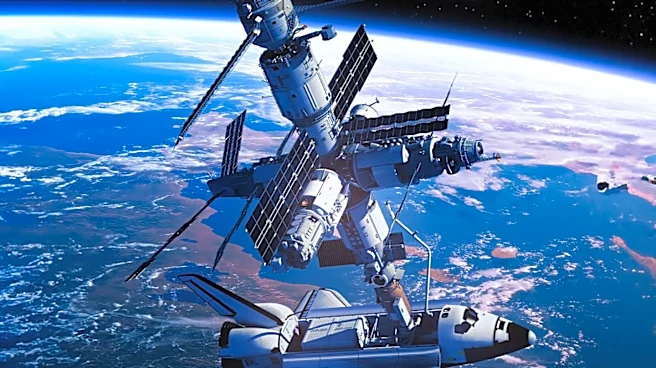





STS-71 stands as a significant milestone in the history of human spaceflight, particularly in the realm of international collaboration. Launched on June 27, 1995, this mission marked the first time an American Space Shuttle, Atlantis, successfully docked with the Russian space station Mir. This event was not just a technical achievement but also a symbol of renewed cooperation between the United States and Russia in space exploration, following decades
of Cold War competition. The mission facilitated crew exchanges, scientific investigations, and logistical resupply, laying groundwork for future joint ventures.
A Series of Historic Firsts
STS-71 was notable for achieving several "firsts" in human spaceflight. It was the 100th U.S. crewed space flight, a testament to the nation's enduring commitment to space exploration. More importantly, it represented the first U.S. Shuttle-Russian Space Station Mir docking and joint on-orbit operations. This docking was the first between a U.S. spacecraft and a Russian spacecraft since the Apollo-Soyuz Test Project in 1975, bridging a twenty-year gap in direct space collaboration. The mission also saw the first on-orbit change-out of a shuttle crew, demonstrating the capability for complex crew rotations in space.
When Atlantis and Mir were linked, they formed the largest spacecraft ever in orbit at that time, with a combined mass of about 225 metric tons. This impressive assembly showcased the engineering prowess of both nations and provided an expansive platform for scientific research. The successful docking and combined operations were critical steps in the broader Shuttle-Mir program, which aimed to foster a spirit of cooperation and learn from each other's experiences in long-duration spaceflight.
Mission Objectives and Scientific Endeavors
The primary objectives of STS-71 were multifaceted. Beyond the historic docking, the mission aimed to deliver a relief crew of two cosmonauts, Anatoly Solovyev and Nikolai Budarin, to Mir. Simultaneously, it retrieved American astronaut Norman Thagard and cosmonauts Vladimir Dezhurov and Gennady Strekalov, who had been part of the Mir-18 crew. This crew exchange was vital for maintaining continuous human presence on Mir and for rotating personnel after long durations in space.
Another key objective involved conducting joint U.S.-Russian life sciences investigations aboard the Spacelab module, which was installed in Atlantis's aft payload bay. Fifteen separate biomedical and scientific investigations were carried out, covering diverse fields such as cardiovascular and pulmonary functions, human metabolism, neuroscience, hygiene, and microgravity research. The Mir-18 crew served as test subjects for many of these investigations, providing valuable data on the effects of prolonged space travel. Logistical resupply of Mir was also a crucial part of the mission, with water, supplies, equipment, and even specially designed spacewalking tools being transferred to the station.
The Journey and Return
The rendezvous sequence for STS-71 began with a precise lift-off, in-plane with Mir's orbit. The Space Shuttle Atlantis adjusted its orbit to achieve the lowest ever perigee altitude flown by an orbiter, facilitating a rapid catch-up rate with Mir. Docking occurred at 9 a.m. EDT on June 29, using an R-bar approach, where Atlantis closed in on Mir from directly below. This method minimizes the number of orbiter jet firings needed for approach. The manual phase of docking was expertly handled by Gibson, with interface contact being nearly flawless, demonstrating remarkable precision.
After five days of combined operations, the spacecraft undocked on July 4. The separation sequence was described as a "cosmic ballet," with the Mir-19 crew temporarily abandoning the station in their Soyuz spacecraft to record images of Atlantis and Mir separating. During this time, Mir experienced a computer malfunction, causing it to drift in attitude. The Mir-19 crew performed a hasty re-docking, monitored by Atlantis, and subsequently replaced computer hardware to regain attitude control. The returning crew of eight equaled the largest crew in Shuttle history, with the Mir-18 crew members lying supine in custom-made recumbent seats to ease their re-entry into Earth's gravity after more than 100 days in space.