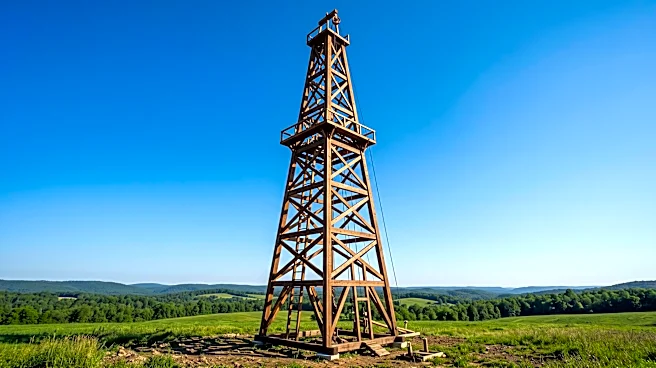








The Pennsylvania oil rush, ignited by Edwin Drake's discovery in 1859, triggered an unprecedented economic boom that reshaped Western Pennsylvania and profoundly influenced the national economy. The rapid expansion of oil wells and refineries transformed quiet towns into bustling centers of commerce, attracting investment and labor. Oil quickly ascended to become one of the most valuable commodities in the United States, driving the expansion of railroads
and establishing petroleum as a major industry. However, this era of rapid growth was not without its challenges, eventually leading to a decline in Pennsylvania's dominance as other oil-rich regions emerged.
The Rapid Rise of Oil Boomtowns
Drake's successful drilling in Titusville sparked an immediate and intense period of development. The oil boom in Pennsylvania mirrored the California gold rush of a decade earlier in its speed and transformative power. Within a short time, the area around Oil Creek saw numerous wells drilled by Seneca Oil Company and other enterprises. In the first year alone, 1859, these wells reportedly produced 4,500 barrels of oil. This rapid success led to the emergence of boomtowns such as Titusville, Oil City, and Pithole within just a few years.
The growth was astonishing. Titusville's population exploded from a mere 250 residents to over 10,000 in little more than five years, leading to its incorporation as a city in 1866. An early chronicler, Reverend S. J. M. Eaton, observed in 1866 that the Oil Creek valley was so densely packed with development that it was impossible to distinguish where one town ended and another began. The infrastructure supporting the industry also grew rapidly; ironworks were established to supply drilling tools, and eight oil refineries were constructed between 1862 and 1868. Pithole, a particularly striking example, grew from four log-cabin farmhouses to a bustling city with over 50 hotels in just five months during 1865, illustrating the intense speculative fervor and rapid urbanization characteristic of the oil rush.
Production Peaks and Global Influence
The economic impact of the Pennsylvania oil rush extended far beyond local boomtowns, significantly boosting national production and international trade. Annual domestic output of crude oil soared dramatically. From a modest 2,000 barrels in 1859, the year of Drake's discovery, production escalated to 4,000,000 barrels by 1869 and reached 10,000,000 barrels by 1873. This rapid expansion was fueled by the ongoing industrial development in Europe, particularly in Britain, where factories began importing large quantities of cheap American oil during the 1860s.
By 1866, U.S. petroleum exports had far surpassed the amount distributed to domestic markets. The value of these exports nearly doubled from $16 million in 1865 to $30 million in 1869. During this period, petroleum's standing among U.S. exports jumped from the sixth most valuable to the second most valuable commodity. At the peak of the oil boom, Pennsylvania wells were producing an astounding one-third of the world's oil, solidifying the state's position as a global energy powerhouse and demonstrating the immense economic power of this newly tapped resource.
The Shifting Landscape of Oil Dominance
Despite its initial dominance, Pennsylvania's reign as the primary oil producer eventually waned. The state's oil production peaked in 1891, reaching 31 million barrels, which accounted for 58% of the nation's total oil output that year. However, 1892 marked the last year that Pennsylvania wells supplied a majority of the oil produced in the U.S. The industry's dynamic nature meant that new discoveries elsewhere would soon challenge Pennsylvania's supremacy. By 1895, Ohio had surpassed Pennsylvania as an oil producer, signaling a shift in the geographical center of the American oil industry.
The decline of the Pennsylvania fields was further accelerated by significant discoveries in other states. By 1907, major oil strikes in Texas, California, and Oklahoma had dramatically altered the national oil landscape. These new fields, with their vast reserves, left Pennsylvania with less than 10% of the nation's oil production. While some oil industry activity continued in Pennsylvania, the era of its unparalleled dominance had concluded, giving way to a more geographically diverse and expansive national oil industry.