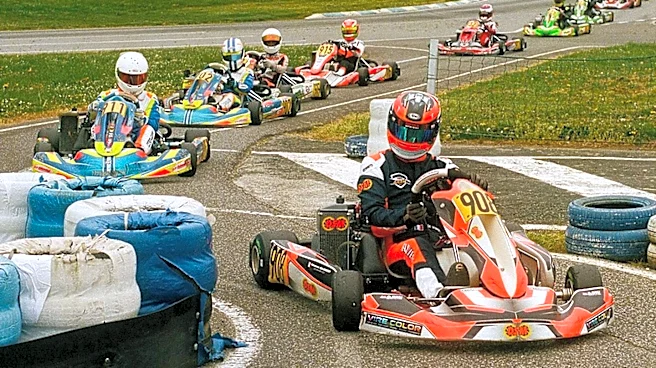





The Commission Internationale de Karting (CIK-FIA), also known as FIA Karting, serves as the paramount governing body for international kart racing. Established in 1962, it is one of six World Championship commissions under the umbrella of the Fédération Internationale de l'Automobile (FIA). Based in Geneva, the CIK-FIA carries significant responsibilities, including setting international kart racing rules and safety standards, and organizing a range
of competitions, most notably the prestigious Karting World Championship. Its influence extends across various aspects of the sport, ensuring consistency, fairness, and the continued development of karting globally.
Core Responsibilities and Sanctioning
The CIK-FIA's primary mandate involves the creation and enforcement of international kart racing rules and safety regulations. This crucial role ensures that competitions are conducted under standardized conditions, promoting fair play and protecting the participants. Beyond regulation, the CIK-FIA is directly responsible for organizing the Karting World Championship, an event widely recognized as the most prestigious karting competition worldwide. This championship has been hosted annually since 1964, making it the second-oldest FIA World Championship after Formula One.
In addition to the World Championship, the CIK-FIA sanctions other significant international kart racing events. These include the Karting European Championship, which is another major competition, and various other international championships. The organization also oversees continental championships such as the CIK-FIA European Championships (covering OK, OK Junior, KZ, KZ2, and Superkart categories) and the CIK-FIA Asia Pacific Championships. This broad oversight ensures a structured progression for drivers and a consistent framework for karting competitions across different regions.
Evolution of Championship Structure and Categories
The CIK-FIA has continuously adapted the structure and categories of its championships to reflect advancements in karting technology and the needs of the sport. For instance, from 2011, the World Championship was disputed over five rounds, each held in a different country. However, from 2014, the format reverted to a single event. This single event structure typically involves one venue organizing the CIK-FIA OK and OK Junior World Championships over one weekend, and another venue in a different weekend hosting the CIK-FIA KZ World Championships, along with the CIK-FIA KZ2 Super Cup and the third and final round of the CIK-FIA Karting Academy Trophy.
The categories themselves have also seen significant evolution under CIK-FIA guidance. In 1968, the CIK-FIA launched the first World Cup for Juniors, demonstrating an early commitment to nurturing young talent. More recently, since 2016, the new generation of Original Karts (OK) machines has taken over from the older KF engines. The CIK-FIA defines these categories, such as the top-tier OK for drivers aged 14 and over, and OK Junior for those between 12 and 14. The organization also oversees gearbox categories like KZ and KZ2, and the specialized Superkart category, which features powerful 250 cc twin-cylinder engines and full bodywork, designed for long racing tracks. These detailed regulations and organizational efforts underscore the CIK-FIA's central role in shaping the landscape of international kart racing.