




Crater Lake National Park, nestled in southern Oregon, stands as a testament to powerful geological forces and dedicated conservation efforts. Established on May 22, 1902, it holds the distinction of being the fifth-oldest national park in the United States and the only one located in Oregon. The park's primary mission is to safeguard Crater Lake itself, along with its surrounding scenic landscapes, unique volcanic features, and rich ecological and cultural
heritage. It also aims to foster understanding and appreciation through enjoyment, education, and inspiration for its visitors.
The Birth of a Lake: Mount Mazama's Legacy
The centerpiece of the park, Crater Lake, is a stunning volcanic crater lake formed within the caldera of a destroyed volcano known as Mount Mazama. This ancient volcano, part of the Cascade Range volcanic arc, was built up over at least 400,000 years, primarily from andesite, dacite, and rhyodacite. The dramatic caldera was created between 6,000 and 8,000 years ago during a massive volcanic eruption. This event led to the collapse of Mount Mazama, with approximately 12 cubic miles of rhyodacite erupted. Following this cataclysmic event, all subsequent eruptions on Mazama have been confined to the caldera.
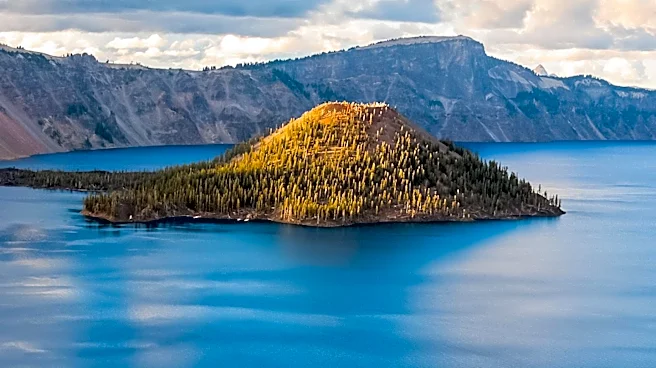
After the caldera's formation, lava eruptions within it created various features, including a central platform, Wizard Island, and Merriam Cone, along with other smaller volcanic structures. A rhyodacite dome eventually formed atop the central platform. Over time, sediments and landslide debris also accumulated on the caldera floor. As the caldera cooled, rain and snow began to collect, gradually forming the lake. Landslides from the caldera rim contributed debris fans and turbidite sediments to the lakebed. Fumaroles and hot springs were common and active during this period, indicating ongoing geological activity.
A Lake of Extraordinary Depth and Clarity
Crater Lake is renowned for its exceptional depth and clarity. With a depth of 1,949 feet (594 m), it is the deepest lake in the United States, ranking tenth globally for maximum depth and fifth for mean depth. The lake's immense depth plays a crucial role in its thermal properties, acting as a heat reservoir that absorbs and traps sunlight. This helps maintain the lake's surface temperature at an average of 55°F (13°C) and its bottom temperature at a consistent 38°F (3°C) throughout the year. While the surface temperature fluctuates slightly, the bottom temperature remains remarkably constant.
The lake's purity is another distinguishing characteristic. Due to the absence of inlets or tributaries, Crater Lake's waters are among the purest in the world, largely free from pollutants. Clarity readings, measured with a Secchi disk, have consistently shown measurements around 120 feet (37 m), which is exceptionally clear for any natural body of water. A record clarity of 142 feet (43 m) was recorded in 1997. However, a more recent reading in 2025 indicated a clarity of 78 feet (24 m), suggesting a potential increase in cloudiness that could point to changes in the lake's physics, chemistry, and ecology. Despite its pristine appearance, the lake has relatively high levels of dissolved salts, total alkalinity, and conductivity, with an average pH typically ranging between 7 and 8.