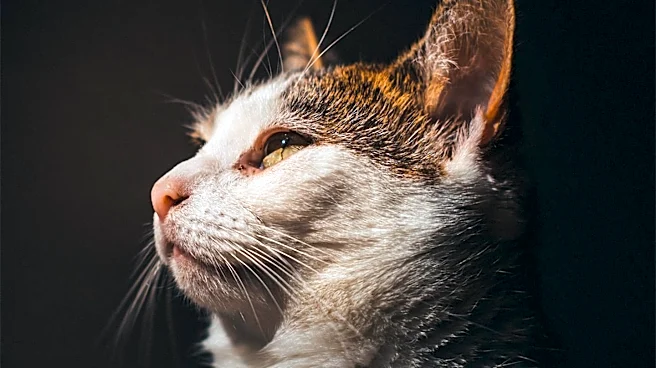










Cats possess a rich and varied repertoire of communication methods, encompassing vocalizations, visual cues through body language, tactile interactions, and olfactory signals. These diverse forms of expression allow cats to convey a wide range of emotions and intentions, both among themselves and with humans. From the subtle flick of a tail to a distinct meow, understanding these signals can deepen the bond between cats and their human companions,
offering insights into their needs and emotional states.
Vocalizations: A Symphony of Sounds
Up to 21 different cat vocalizations have been observed, categorized in various ways by researchers. Mildred Moelk, in 1944, conducted the first phonetic study of cat sounds, classifying 16 vocal patterns into three main groups: sounds made with a closed mouth (murmurs like purring and trilling), sounds made by opening and then gradually closing the mouth (meowing, howling, yowling), and sounds made with the mouth held tensely open (growls, snarls, hisses, spits, chattering, and chirping). Moelk even suggested cats have six distinct meow forms to express friendliness, confidence, dissatisfaction, anger, fear, and pain, in addition to eight sounds related to mating and fighting.Other classifications exist, such as those by Brown et al., who categorized vocal responses based on behavioral context, including kitten separation from mothers, food deprivation, pain, aggressive behaviors, and acute stress. Owens et al. focused on acoustic structures, dividing vocalizations into tonal, pulse, and broadband sounds, with further subcategories. Miller simplified these into purr, meow, chirrup, chirp, call, growl/snarl/hiss, and howl/moan/wail, highlighting the complexity and nuance within feline vocal communication.
The Enigmatic Purr and the Versatile Meow
The purr is a continuous, soft, vibrating sound, though its exact mechanism and purpose remain somewhat mysterious. Cats purr when hungry, happy, or anxious, and it's often seen as a sign of contentment. However, cats also purr when ill, tense, or in pain, suggesting it may also serve as a self-soothing or healing mechanism. Research indicates that the larynx can produce purring sounds when air passes through it, without requiring muscle contraction, due to connective tissue in the vocal folds that lowers sound frequency. This low-frequency vibration, often with harmonics, is thought to be produced by the rapid dilation and constriction of the glottis during both inhalation and exhalation.The meow is perhaps the most familiar sound of adult cats, capable of conveying a multitude of messages: assertive, plaintive, friendly, demanding, or even silent. Kittens produce a high-pitched meow, or