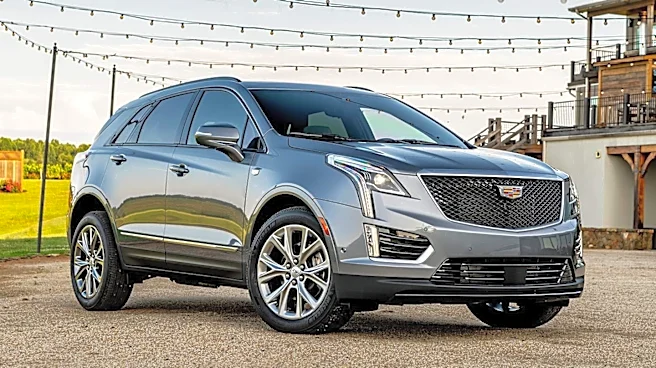









Cadillac, a name synonymous with American luxury automobiles, began its journey in 1902, emerging from the remnants of the Henry Ford Company. Founded in Detroit, Michigan, the brand quickly distinguished itself through a commitment to precision engineering and stylish luxury finishes. This dedication propelled Cadillac to become one of the world's first automotive brands and a leader in the United States, establishing a reputation that would eventually
earn it the slogan, "Standard of the World." Its early history is marked by significant technological breakthroughs and a relentless pursuit of quality that laid the groundwork for modern mass production techniques.
From Henry Ford Company to Cadillac Automobile Company
The origins of Cadillac trace back to a dispute between Henry Ford and his investors. In March 1902, Ford, along with several key partners, departed from the Henry Ford Company. Ford's financial backers, William Murphy and Lemuel Bowen, then enlisted engineer Henry M. Leland of Leland & Faulconer Manufacturing Company to assess the plant and equipment, with the intention of liquidating the company's assets. However, Leland, a skilled machinist and entrepreneur, saw potential beyond liquidation. He successfully convinced Murphy and Bowen to continue manufacturing automobiles, proposing the use of his own proven single-cylinder engine.
This pivotal decision led to the establishment of the Cadillac Automobile Company on August 22, 1902. The new company took over the former Henry Ford Company factory located at Cass Street and Amsterdam Avenue in Detroit. The brand was named in honor of Antoine de la Mothe Cadillac, the French explorer who founded Detroit in 1701, and whose coat of arms inspired the iconic Cadillac crest. This foundational period set the stage for a company that would not only produce luxury vehicles but also drive significant advancements in the burgeoning automotive industry.
Pioneering Precision and Interchangeability
From its inception, Cadillac prioritized precision engineering, a philosophy championed by Henry M. Leland. This focus was dramatically demonstrated in 1908 when Cadillac participated in a crucial interchangeability test in the United Kingdom. The company successfully showcased that its component parts were interchangeable, a groundbreaking achievement at the time. This feat earned Cadillac the Royal Automobile Club of the United Kingdom's Dewar Trophy for the most important advancement of the year in the automobile industry. This recognition was so significant that it directly inspired the company's enduring slogan, "Standard of the World."
The concept of interchangeable parts was revolutionary, laying the foundation for the modern mass production of automobiles. Before this, car parts were often custom-fitted, making repairs and manufacturing inefficient. Cadillac's success in this area proved that high-quality, precisely manufactured components could be produced consistently, enabling greater efficiency and reliability. This commitment to precision engineering was a core tenet that distinguished Cadillac in its early years and contributed to its rapid ascent in the luxury car market.
Technological Leadership and Growth
Cadillac continued its trajectory of innovation, securing the Dewar Trophy again in 1912. This second award recognized the company's pioneering integration of electric starting and lighting systems into a production automobile. This was a major convenience and safety improvement, eliminating the need for dangerous hand-cranking to start vehicles and providing reliable illumination. These advancements, along with others like full electrical systems, the clashless manual transmission, and the steel roof, positioned Cadillac at the forefront of technological progress in the automotive industry.
By 1909, when General Motors purchased the company, Cadillac had already solidified its status as a premier luxury car manufacturer in America. Under GM's ownership, Cadillac became the conglomerate's prestige division, dedicated to producing large luxury vehicles. It also served as GM's default marque for "commercial chassis" institutional vehicles, such as limousines, ambulances, hearses, and funeral home flower cars, which were custom-built by aftermarket manufacturers. This strategic positioning placed Cadillac at the pinnacle of GM's vehicle hierarchy, above brands like Buick, Oldsmobile, Oakland, and Chevrolet, further cementing its reputation for excellence and luxury.
The Legacy of Early Innovation
The early innovations and commitment to quality established by Cadillac had a lasting impact on the automotive industry. The brand's development of three engines, particularly its V8, set a new standard for the American automotive industry. This focus on powerful and refined engines, combined with its advancements in manufacturing and electrical systems, ensured Cadillac's place as a leader. The company's foundational years were not just about creating luxury cars; they were about defining what a modern automobile could be, pushing the boundaries of engineering, and setting benchmarks for quality and innovation that resonated throughout the industry and beyond.