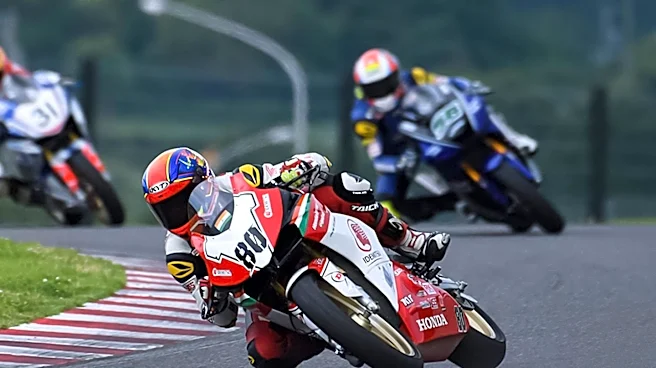




The Superbike World Championship is not merely a series of races; it's a dynamic arena where the prowess of riders, the strategic might of manufacturers, and the relentless pursuit of technical innovation converge. Since its founding in 1988, this international superbike racing series has captivated audiences by showcasing highly modified production motorcycles in intense competition. Unlike MotoGP, which features bespoke prototypes, Superbike racing's
reliance on road-going models creates a unique connection between the track and the showroom, fueling a competitive spirit that extends beyond the finish line to influence motorcycle development and sales.
Iconic Rivalries and Rider Dominance
The history of the Superbike World Championship is punctuated by legendary rivalries and periods of rider dominance that have etched themselves into the sport's lore. One of the most compelling sagas unfolded in the 1990s and early 2000s, featuring Carl Fogarty and Troy Bayliss. Fogarty, riding for Ducati, achieved an unprecedented four titles between 1993 and 1999, also securing runner-up positions twice. His consistent success on Ducati machines established a benchmark for future competitors. Troy Corser also contributed to Ducati's strong showing during this period, winning the 1996 title.
The early 2000s brought another iconic rivalry to the forefront: Colin Edwards versus Troy Bayliss. The 2002 season is particularly celebrated for Edwards' remarkable comeback. Bayliss started the season with six consecutive wins and held a significant 58-point lead by the end of the first race at WeatherTech Raceway Laguna Seca. However, Edwards mounted an extraordinary charge, winning all nine remaining races, a feat aided by a crash for Bayliss at Assen. The championship culminated in the "Showdown at Imola," a wheel-to-wheel battle in the final race that saw Edwards clinch his second title. More recently, Jonathan Rea has demonstrated exceptional dominance, securing his second consecutive Superbike World Championship title in 2016 and his third in 2017 for Kawasaki, further cementing his place among the sport's greats.
Manufacturer Strategies and Technical Evolution
Manufacturers play a pivotal role in the Superbike World Championship, using the series as a proving ground and a marketing platform. The slogan "Win on Sunday; Sell on Monday" perfectly encapsulates this synergy. Ducati's early dominance, particularly with its 1,000 cc V-twin engines, spurred competitors like Honda to innovate. Honda's introduction of the VTR1000 SPW in 2000 was a direct response, immediately yielding a championship win with Colin Edwards. This constant push and pull between manufacturers drive technical evolution within the series.
Rule changes often reflect these competitive dynamics. In 2003, the FIM allowed 1,000 cc machines of various cylinder configurations, but a shift in MotoGP's focus on four-stroke engines led Japanese manufacturers to divert resources, leaving the Superbike World Championship with limited factory involvement from brands other than Ducati and Suzuki. This period, sometimes derisively called "the Ducati Cup," highlighted the impact of manufacturer commitment. Later, in 2008, Ducati successfully lobbied for rules to accommodate its 1,099 cc V-twin 1098, allowing 1,200 cc twins to compete against 1,000 cc four-cylinder bikes, albeit with weight penalties and air restrictors. These adjustments demonstrate the FIM's efforts to maintain competitive balance while acknowledging manufacturers' production realities. The championship also saw the introduction of control tires from Pirelli in 2004, a move aimed at leveling the playing field, though initially met with controversy from other tire manufacturers and teams.
Race Weekend Structure and Scoring System
The Superbike World Championship race weekend structure has also evolved to enhance competition and spectator engagement. Since 2019, each round features two full-length races and an additional ten-lap sprint race known as the Superpole race. The results from all three races contribute to determining three annual World Championships: one for riders, one for manufacturers, and, as of 2024, a Teams World Championship. This multi-race format provides more opportunities for points and intensifies the competition throughout the weekend.
Further refinements to the race format include changes to the starting grid. For instance, in 2017, the starting grid for the second race was revised: riders placed fourth to ninth in Race 1 were promoted to the first two rows for Race 2, followed by the third, second, and winner of Race 1 on the third row. The remaining riders were then sorted based on Superpole results. These intricate rules ensure that every session, from qualifying to the final race, holds significant weight, contributing to a championship that is as much about strategic planning as it is about raw speed and rider skill.