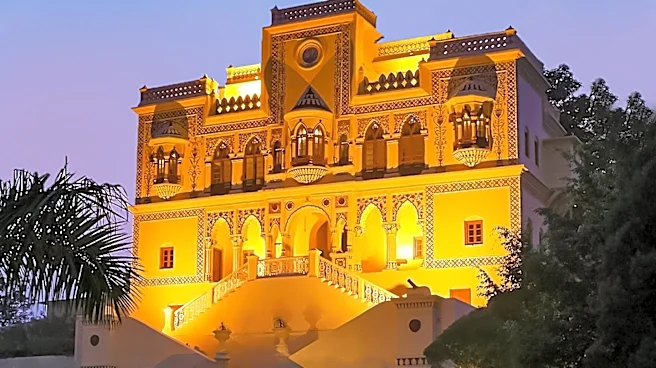
The City Palace of Jaipur stands as a monumental complex in the heart of Jaipur, Rajasthan, India, embodying centuries of royal history and architectural evolution. Its origins trace back to the early 18th century, with initial constructions spearheaded by Maharaja Sawai Jai Singh II between 1729 and 1732. This period saw the establishment of the complex's outer walls, laying the foundation for what would become a sprawling royal residence and administrative
center. Over the centuries, successive rulers continued to expand and embellish the palace, adding new structures and courtyards that reflect a blend of diverse architectural influences, making it a living testament to the rich heritage of the Jaipur State.
Founding and Early Development
The history of the City Palace is intrinsically linked with that of Jaipur city itself and its ruling lineage, beginning with Maharaja Sawai Jai Singh II, who reigned from 1699 to 1744. He is widely credited with initiating the construction of the palace complex, overseeing the building of its extensive outer walls. Initially, Jai Singh II governed from Amber, located about 11 kilometers from Jaipur. However, due to increasing population and water scarcity in Amber, he made the strategic decision to relocate his capital to Jaipur in 1727. He meticulously planned Jaipur city in six blocks, separated by broad avenues, adhering to the classical principles of Vastushastra and other similar treatises. This grand urban design was executed under the architectural guidance of Vidyadar Bhattacharya, a Bengali architect who rose from an accounts-clerk to the Chief Architect of the royal court.
Architectural Fusion and Evolution
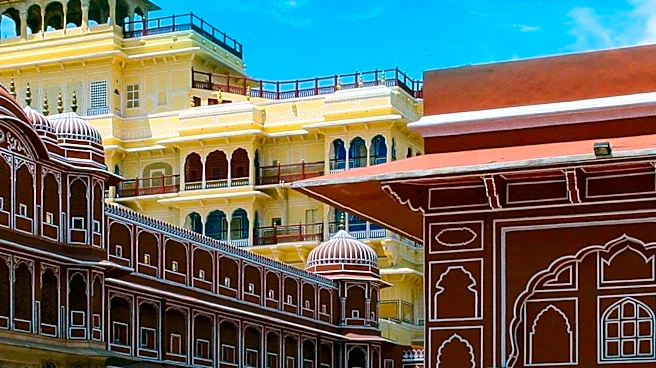
The City Palace is renowned for its distinctive architectural style, which represents a harmonious fusion of Rajput, Mughal, and European influences. This blend is evident in various structures throughout the complex, from the intricate carvings to the overall layout of courtyards and buildings. While Vidyadar Bhattacharya is primarily credited with the initial urban planning and architectural design, later additions and modifications were also influenced by figures like Samuel Swinton Jacob, the State's executive engineer, who contributed to structures like the Mubarak Mahal and Rajendra Pol around 1900. This continuous evolution over nearly two centuries, from the early 18th to the 20th century, resulted in a complex that showcases a rich tapestry of design elements from different eras.
Key Structures and Their Significance
The palace complex is a unique and special assembly of numerous courtyards, buildings, pavilions, gardens, and temples. Among its most prominent and frequently visited structures are the Chandra Mahal, Mubarak Mahal, and the Shri Govind Dev Temple. The Chandra Mahal, one of the oldest buildings, features seven floors, a number considered auspicious by Rajput rulers, with each floor serving a distinct purpose or adorned with unique decorations, such as the colored glasswork of Shobha Niwas or the blue and white motifs of Chhavi Niwas. The Mubarak Mahal, built around 1900, was originally intended for receiving foreign guests and now houses museum offices and a textile gallery, showcasing the palace's adaptive reuse over time.
Enduring Royal Residence and Cultural Hub
Despite parts of the City Palace being converted into a museum, a significant portion, particularly the Chandra Mahal, continues to serve as a royal residence for the Maharaja of Jaipur, who is the head of the Kachwaha Rajput clan. This dual function as both a historical museum and a living royal abode underscores its enduring importance. The palace also remains a vibrant center for cultural and religious activities. For instance, the Sarvato Bhadra, originally the Hall of Private Audience, is still used for important ritual buildings and royal festivals like Dusshera, Gangaur, and Teej. During these festivals, images of goddesses are placed in palanquins in the hall before being carried in procession around the city, highlighting the palace's role in preserving traditional customs and celebrations.