




Santorini, officially known as Thira or Thera, is a Greek island that has captivated visitors for millennia, evolving from ancient settlements to a world-renowned tourist destination. Its unique landscape, shaped by a massive volcanic eruption around 1600 BCE, provides a dramatic backdrop for a rich tapestry of history, culture, and natural beauty. From its earliest inhabitants to its modern-day status as a magnet for travelers, Santorini's allure
lies in its blend of archaeological wonders, picturesque villages, and the enduring spirit of its people. The island's transformation into an iconic travel spot is a testament to its resilience and the captivating experiences it offers.
Ancient Roots and Archaeological Treasures
Santorini has been known since ancient times and has been inhabited by various civilizations throughout the millennia. The southern part of Thira is home to two significant ancient cities from different eras. The oldest and most scientifically valuable is Ancient Akrotiri, a Bronze Age city built by the Minoans, a civilization primarily known from Crete. When the volcano erupted around 1600 BCE, the Minoan city was buried under volcanic pumice and ash, much like Pompeii, leading to its incredible preservation. The entire city is now covered by a giant canopy, allowing comfortable visits even during hot summer months.
The Phoenicians later founded their own city on the island, which they knew as Kalliste, and subsequently renamed it after their leader, Theras. This is how the island became known as Thera in ancient times, a name from which the modern name Thira is derived. The city of Ancient Thera thrived for centuries, its prosperity evidenced by gold coins and numerous archaeological artifacts discovered during excavations. The ruins of Ancient Thera are located on Gavrilos Hill, between Kamari and Perissa, offering both historical insight and breathtaking views. While frequent seismic and volcanic activity in the archipelago has left few structures intact over geological timescales, a remarkable exception is the Temple of Agios Nikolaos Marmaritis, a marble temple near Emporio dating to the 3rd century, which is still used for liturgical purposes today.
Medieval Fortifications and Cultural Heritage
The Santorini archipelago was conquered by the Venetians in 1207, leading to the construction of five fortified castles from the 13th century onward. These fortifications were built to protect the island from invaders, particularly the Ottomans, with whom the Venetians were in perpetual conflict from 1396 until 1718. Among these, La Ponta in Akrotiri is one of the largest, while Pyrgos Castle is noted as the newest and best preserved. For those with limited time, the 15th-century Castle of Emporio is a recommended visit, as it still forms the center of present-day Emporio, featuring narrow streets and picturesque churches.
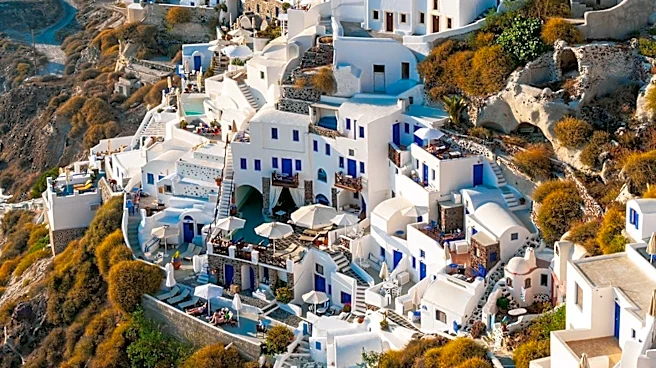
Beyond its ancient and medieval structures, Santorini boasts a rich cultural heritage reflected in its traditional Cycladic architecture. Villages like Fira, the capital, showcase a blend of Venetian and Cycladic styles, with white cobblestone streets bustling with shops, tavernas, hotels, and cafes, all clinging to the caldera rim 275 meters above the port. Just above Fira is Imerovigli, offering magnificent views from the highest point of the caldera cliffs. At the northern end of the island lies Oia, a quintessentially Santorinian town with whitewashed walls carved into volcanic rock and blue domes rising above the stunning Ammoudi Bay. Oia is particularly famous for its sunsets, reputed to be among the world's most beautiful, drawing crowds of people each evening.
Modern Tourism and Island Life
In the early 1950s, Santorini's economy was in decline, and tourism was a nascent industry, primarily attracting wealthy individuals on yacht cruises. The island's children would present arriving passengers with flowers and light small lanterns along the steps from Fira to the port as a farewell gesture. A significant event in 1956, a major earthquake, caused widespread destruction and prompted many residents to leave. However, the island has since undergone a remarkable transformation, rebuilding itself into the iconic tourism destination it is today.
Modern Santorini offers a wealth of attractions for curious travelers, from fascinating museums to black sand beaches. The Museum of Prehistoric Thera tells the story of the ancient Bronze Age settlement at Akrotiri, while the Archaeological Museum of Thera houses collections of pottery, amphorae, and figures from the Proto-Cycladic period to the Classical period. The island also features museums dedicated to naval history, tomatoes, wine, and ethnography. With its unique natural beauty, historical depth, and vibrant cultural scene, Santorini continues to be a pole of attraction for both Greek and international celebrities, as well as countless tourists seeking an unforgettable experience in the Aegean.