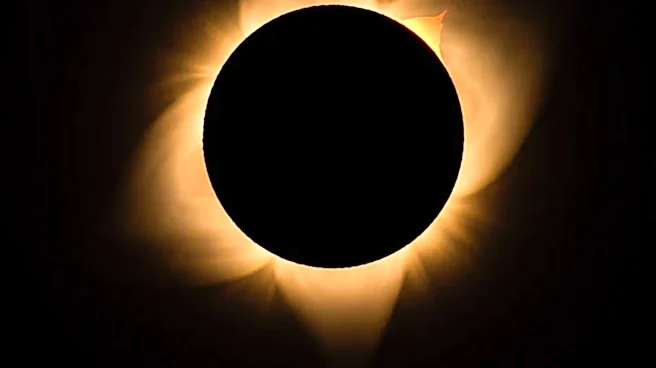










The total solar eclipse of August 21, 2017, was a prime example of a fascinating celestial phenomenon, offering a clear demonstration of how the Moon can completely obscure the Sun from Earth's perspective. This event, visible across the United States, provided a unique opportunity to observe the intricate dance between our planet, its natural satellite, and our star. Understanding the specific characteristics and timing of this eclipse helps to demystify
the mechanics behind such awe-inspiring occurrences.
Defining the Total Phase and Its Reach
A total solar eclipse occurs when the Moon passes directly between the Sun and Earth, blocking all direct sunlight and turning day into a temporary twilight. For the August 21, 2017, event, this total phase was observable within a relatively narrow band across the United States. This path of totality, which was approximately 115 kilometers (71 miles) wide, stretched from the Pacific coast to the Atlantic coast, encompassing states like Oregon, Idaho, Wyoming, Nebraska, and South Carolina.
Beyond this specific path, a partial eclipse was visible over a much wider area. This meant that while the Sun was not entirely covered, a significant portion of it was obscured by the Moon. The partial eclipse extended its reach from northern Canada down to northern South America, and was also seen in northwestern Europe, northwestern Africa, and the easternmost parts of Asia, highlighting the vast geographical extent of even a localized total eclipse event.
Key Astronomical Measurements and Timing
The August 21, 2017, eclipse had several defining astronomical characteristics. Its maximum duration of totality was 160 seconds, or 2 minutes and 40 seconds, a relatively short but impactful period during which the Sun's corona became visible. The greatest eclipse, the point where the Moon's shadow was closest to the center of Earth, occurred at 18:26:40 UTC, at coordinates 37°00′N 87°42′W.
Further technical details include a gamma value of 0.4367 and a magnitude of 1.0306. Gamma is a measure of how centrally the Moon's shadow strikes Earth, with values closer to zero indicating a more central alignment. The magnitude indicates the fraction of the Sun's diameter obscured by the Moon. The eclipse's progression was precisely timed: the partial phase began at 15:46:48 UTC, the total phase started at 16:48:32 UTC, and the total phase concluded at 20:01:35 UTC, with the partial phase ending at 21:04:19 UTC. These precise timings are crucial for both scientific observation and public viewing.
The Saros Cycle and Eclipse Recurrence
The 2017 solar eclipse is part of a larger astronomical pattern known as the Saros cycle. Specifically, it was the 22nd eclipse in Saros series 145, which comprises a total of 77 eclipses. The Saros cycle is a period of approximately 18 years, 11 days, and 8 hours, after which the Earth, Moon, and Sun return to approximately the same relative geometry, leading to a very similar eclipse. This predictability allows astronomers to forecast eclipses far into the future.
An interesting observation regarding the 2017 eclipse is its similarity in path to the solar eclipse predicted for August 12, 2045. Both eclipses cross the U.S. from the Pacific to the Atlantic coast. This similarity is explained by the concept of ascending and descending nodes in the Moon's orbit. When a solar eclipse occurs in mid-August at an ascending node (moving south to north during odd-numbered saros cycles), its path tends to track coast-to-coast across the U.S. This understanding of saros cycles and orbital mechanics provides a framework for comprehending the recurring nature and geographical patterns of solar eclipses.