




Ernest Orlando Lawrence, an American physicist, left an indelible mark on 20th-century science, most notably through his invention of the cyclotron, for which he received the Nobel Prize in Physics in 1939. Born in Canton, South Dakota, in 1901, Lawrence's career was characterized by groundbreaking innovation and a strong belief in large-scale scientific endeavors, often referred to as "Big Science." His work extended beyond theoretical physics into
practical applications, including uranium-isotope separation for the Manhattan Project and the establishment of major national laboratories that bear his name today.
The Birth of the Cyclotron
Lawrence's journey into physics began with his education at the University of South Dakota and the University of Minnesota, culminating in a PhD in physics from Yale in 1925. His academic prowess led him to the University of California, Berkeley, where he became an associate professor in 1928 and, remarkably, the youngest full professor just two years later. It was during his time at Berkeley that a pivotal moment occurred. While in the library one evening, Lawrence encountered a diagram of an accelerator designed to produce high-energy particles. This sparked an idea: how could such a device be made more compact?
His contemplation led to the revolutionary concept of a circular accelerating chamber positioned between the poles of an electromagnet. This ingenious design was the foundation of the first cyclotron. The cyclotron allowed for the acceleration of particles to high energies in a much more confined space than previous linear accelerators, opening new avenues for research in nuclear physics. This invention not only earned him the highest scientific honor but also laid the groundwork for much of modern particle physics.
Expanding the Frontiers of Physics and Medicine
Following the success of his initial cyclotron, Lawrence embarked on building a series of increasingly larger and more complex versions. His Radiation Laboratory, which became an official department of the University of California in 1936 with Lawrence at its helm, became a hub of innovation. Beyond its primary use in physics research, Lawrence was a strong proponent of applying the cyclotron to medical research, particularly in the study and use of radioisotopes. This foresight helped bridge the gap between fundamental physics and practical medical applications, pioneering the field of nuclear medicine.
His brother, John H. Lawrence, a physician, would become a pioneer in this very field, further illustrating the family's impact on scientific and medical advancements. The collaborative spirit and interdisciplinary approach fostered by Lawrence at his laboratory were crucial in expanding the utility of his inventions beyond pure theoretical physics, demonstrating the broad potential of particle acceleration technology.
From Wartime Contributions to "Big Science" Advocacy
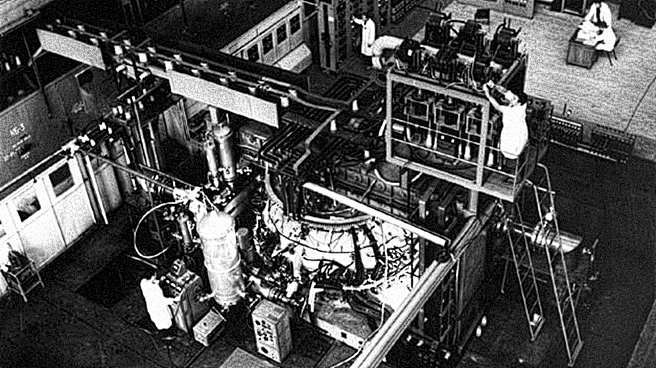
During World War II, Lawrence's expertise and the capabilities of his Radiation Laboratory were critical to the war effort. He developed electromagnetic isotope separation, a process that utilized devices known as calutrons. These calutrons were a unique hybrid, combining elements of standard laboratory mass spectrometers and his own cyclotron technology. This method was employed in a massive electromagnetic separation plant, known as Y-12, built at Oak Ridge, Tennessee, for the purpose of uranium enrichment for the Manhattan Project. While the process was recognized as inefficient, it proved effective in its crucial wartime role.
After the war, Lawrence became a vocal and influential advocate for government funding of large-scale scientific programs. He championed the concept of "Big Science," emphasizing the necessity of substantial financial investment and large-scale machinery to tackle complex scientific challenges. His advocacy played a significant role in shaping the landscape of post-war scientific research in the United States. He also strongly supported Edward Teller's initiative for a second nuclear weapons laboratory, which Lawrence helped establish in Livermore, California. In recognition of his profound contributions, both the Lawrence Berkeley National Laboratory and the Lawrence Livermore National Laboratory were renamed in his honor after his death. Furthermore, chemical element number 103, lawrencium, was named after him following its discovery at Berkeley in 1961, cementing his legacy in the scientific world.