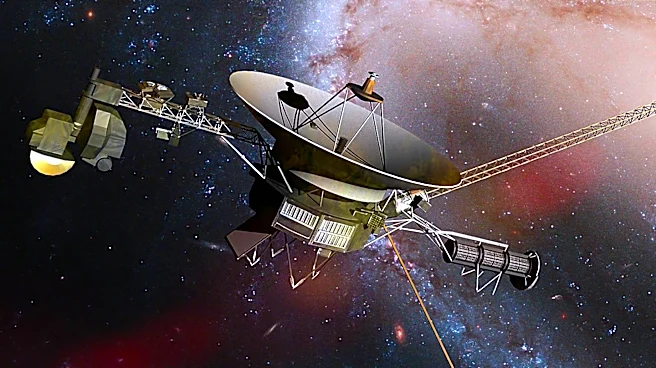





Voyager 1, launched by NASA in 1977, is not just a space probe; it is a testament to enduring engineering and design. Built by the Jet Propulsion Laboratory (JPL), this spacecraft has defied expectations, operating for over four decades and venturing into interstellar space. Its longevity and continued functionality are due to a sophisticated array of components, from its power source and communication systems to its onboard computers and scientific
instruments. Understanding these technological marvels provides insight into how humanity can project its presence and scientific inquiry billions of miles away from Earth.
Powering the Distant Explorer: Radioisotope Thermoelectric Generators
At the heart of Voyager 1's remarkable endurance are its three radioisotope thermoelectric generators (RTGs), mounted on a boom. Each MHW-RTG unit contains 24 pressed spheres of plutonium-238 PuO2 oxide. At the time of launch, these RTGs generated approximately 470 watts of electric power, with the remaining energy dissipated as waste heat. This nuclear power source is crucial because, unlike solar panels, RTGs do not rely on sunlight, making them ideal for missions far from the Sun.
The power output of the RTGs naturally declines over time due to the 87.7-year half-life of the plutonium fuel and the gradual degradation of the thermocouples. Despite this, current projections indicate that these generators may continue to provide enough power to operate at least one science instrument into the 2030s, and potentially return engineering data until 2036. This long-term power supply is a fundamental reason why Voyager 1 can continue its mission far beyond the heliosphere, sending back data from a region no other spacecraft has explored.
Communication Across Billions of Miles
Maintaining communication with a spacecraft billions of miles away presents immense challenges, yet Voyager 1's radio communication system was specifically designed to function up to and beyond the limits of the Solar System. The probe is equipped with a 3.7-meter (12 ft) diameter high-gain Cassegrain antenna. This antenna is vital for both sending and receiving radio waves, facilitating two-way communication with Earth via the three Deep Space Network (DSN) stations located around the globe.
Voyager 1 typically transmits data to Earth over Deep Space Network Channel 18, utilizing frequencies of either 2.3 GHz or 8.4 GHz. In return, signals from Earth are transmitted to Voyager at 2.1 GHz. As of 2025, signals from Voyager 1 take more than 23 hours to reach Earth, a clear indication of its vast distance. When direct communication is not possible, the spacecraft's digital tape recorder (DTR) can store approximately 64 megabytes of data for later transmission, ensuring that valuable scientific information is not lost.
Onboard Intelligence and Control Systems
The operational precision of Voyager 1 relies on its sophisticated onboard computer systems and attitude control mechanisms. The computer command subsystem (CCS) is responsible for controlling the cameras and contains fixed computer programs for critical functions such as command decoding, fault-detection and fault-correction routines, antenna pointing, and spacecraft sequencing. This computer is an improved version of those used in the 1970s Viking orbiters, showcasing continuous technological advancement.
Unlike many modern probes, the operation of Voyager 1's visible light cameras is not autonomous but is controlled by an imaging parameter table within the Flight Data Subsystem (FDS). The Attitude and Articulation Control Subsystem (AACS) is crucial for maintaining the spacecraft's orientation. It ensures the high-gain antenna remains pointed towards Earth, manages attitude changes, and directs the scan platform. The AACS systems on both Voyager probes are identical and incorporate 16 hydrazine thrusters, three-axis stabilization gyroscopes, and referencing instruments, along with redundant units and eight backup thrusters, all designed to keep the probe's radio antenna precisely aimed at Earth. This intricate network of systems has allowed Voyager 1 to navigate, observe, and communicate effectively throughout its historic journey.