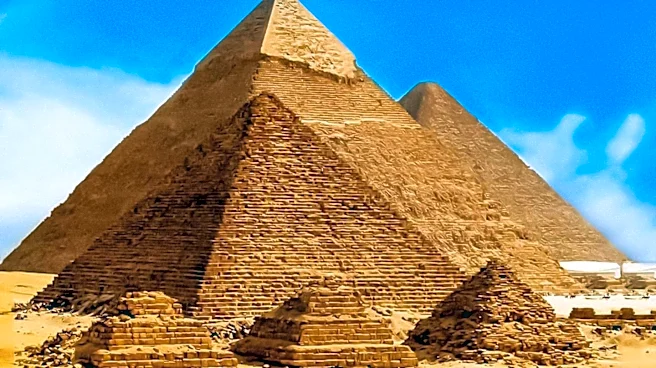







The construction of the Giza pyramid complex represents one of the most ambitious architectural endeavors in human history. These colossal structures, built between approximately 2600 and 2500 BC during the Fourth Dynasty of ancient Egypt, required an extraordinary combination of engineering ingenuity, vast resources, and a highly organized workforce. Understanding how these pyramids were built involves examining the methods used to quarry, transport,
and assemble millions of tons of stone, a process that continues to fascinate and inspire.
Quarrying and Transporting Massive Stones
The primary challenge in pyramid construction was the handling of immense quantities of stone. The Great Pyramid alone incorporated 5.5 million tons of limestone and 8,000 tons of granite. The majority of this stone was quarried directly on the Giza site, indicating a strategic use of local geological resources. However, specific types of stone, such as the white limestone used for the exterior casing, were sourced from Tura. This required a sophisticated transportation system, involving barges to move the stone across the Nile River to the Giza plateau.
Construction theories largely agree on the fundamental principle of moving huge stones from a quarry and then dragging and lifting them into place. One widely accepted method for ground transportation involved placing large slabs of stone onto wooden sledges. These sledges would then be pulled over ground that was likely wetted to create a smoother surface, reducing friction and making it easier to move the heavy loads. This technique, while seemingly simple, would have required immense coordination and manpower.
Engineering and Assembly Techniques
Ancient Egyptian architects likely developed and refined their construction techniques over time. The process began with selecting a stable foundation, typically a relatively flat area of bedrock rather than unstable sand. After careful surveying to establish the precise layout, the pyramids were constructed in horizontal levels, one on top of the other. This layered approach provided structural stability and allowed for systematic progress.
For shaping the stones, different tools were employed based on the material. Softer limestone was cut and chiseled using copper tools. For the much harder granite, rough powders and sands were used to wear down the rock, with copper tools then used for the final cutting. A critical aspect of achieving the pyramids' iconic symmetrical shape was ensuring that all exterior casing stones were uniform in height and width. Workers likely marked each block to indicate the precise angle of the pyramid wall and meticulously trimmed the surfaces to ensure a tight, seamless fit. While the outer surface was originally smooth, polished limestone, most of this has either eroded over millennia or was removed for other building projects during the Middle Ages.
The Workforce and Construction Timeline
The scale of the Giza pyramid projects necessitated a substantial workforce. While early accounts, such as that of the Greek historian Herodotus, suggested 100,000 workers in three-month shifts over 20 years, modern historians offer a more refined estimate. They posit that the construction of the Great Pyramid likely took between 20 and 27 years, involving a year-round workforce of approximately 20,000 to 30,000 individuals. This suggests a highly organized and sustained effort, rather than a seasonal or forced labor model.
New insights into the final stages of the Great Pyramid's construction were provided by the 2013 discovery of the Wadi el-Jarf papyri, particularly the diary of an inspector named Merer. His journal details his team's assignment to deliver white limestone from the Tura quarries to Giza, offering a rare firsthand account of the logistical challenges and daily operations involved in this monumental undertaking. These findings continue to enhance our understanding of the sophisticated planning and human effort that brought the Giza pyramids to life.