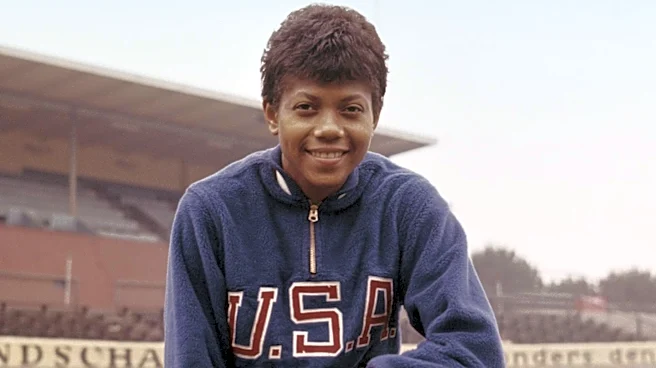










Wilma Glodean Rudolph, born on June 23, 1940, in Saint Bethlehem, Tennessee, overcame significant health challenges in her early life to become a world-renowned track and field athlete. Her journey from a premature birth and a battle with polio to winning multiple Olympic gold medals is a testament to her resilience and determination. Rudolph's story is not just one of athletic achievement, but also of triumph over adversity, making her an enduring
symbol of hope and inspiration.
Early Life and Health Struggles
Wilma Rudolph was born prematurely, weighing approximately two kilograms. Her family lived in modest circumstances in a home without electricity and with an outhouse. She was the twentieth of twenty-two children from her father Ed Rudolph's two marriages. Her father worked as a baggage porter for the railroad, and her mother, Blanche, took on occasional jobs as a maid for affluent white families. Neither of her parents had completed elementary school.
Rudolph's childhood was marked by a series of severe illnesses, including measles, scarlet fever, whooping cough, and mumps. She also suffered from prolonged colds and twice experienced bilateral pneumonia. The most significant challenge was polio, which affected one of her legs, most sources indicating her left leg. Rudolph herself later described her leg as crooked with her foot turned inward. At the age of five, she began wearing a steel brace to straighten her leg. She found the psychological impact of the brace, which she wore for several years, devastating, as it constantly reminded her that something was wrong with her. Other children in her neighborhood often mocked and excluded her due to her paralysis. Rudolph described herself as a sensitive person, and her prolonged illness made her feel very insecure and created a deep fear of not being liked.
The Road to Recovery and Athletic Beginnings
To receive physical therapy, Rudolph and her mother traveled twice a week, and later once a week, to the Meharry Medical Center in Nashville, located 80 kilometers away. Initially, Rudolph was homeschooled by her mother. By the age of seven, her therapy had progressed sufficiently for her to walk independently with medical shoes, allowing her to attend Cobb Elementary School for the second grade. This school was part of the racially segregated school system in the U.S. South during the 1950s, meaning only African American children could attend, and it received less funding and fewer teachers than schools for white children.
During her elementary school years, Rudolph's legs gradually regained function through therapy. At nine years old, she attended church without her leg brace for the first time. By age ten, she concluded her treatments at the Meharry Medical Center, and by twelve, she could walk without any medical assistance. After shedding her leg brace, Rudolph began playing basketball, following her older sister Yvonne onto the girls' school team at Burt High School, coached by Clinton Gray. In her first three years of high school, Rudolph was a substitute player, seeing only sporadic action. However, by her sophomore year, she became a starter. That same school year, her team won the Middle East Tennessee Conference title and placed third in the Tennessee state championships. Rudolph scored 803 points in 25 games that season, setting a record for Black girls' basketball in Tennessee. During Rudolph's time in school, all high school sports in Tennessee were completely segregated between white and Black schools. Alongside basketball, Rudolph joined the high school track and field team at the end of eighth grade, also coached by Clinton Gray. Gray, who lacked specialized track and field knowledge, had primarily formed the team to offer his players additional training opportunities outside the basketball season. Rudolph quickly displayed significant running talent, winning all the sprint races she entered at regional competitions in her freshman year, covering distances from 50 to 200 yards. These early competitions were often poorly organized, with no marked lanes and Rudolph running in tennis shoes.
Overcoming Setbacks and Discovering Potential
At the end of her sophomore year in the spring of 1956, Rudolph experienced a significant athletic setback at the Tuskegee Relays, a prestigious competition at Tuskegee University in Alabama where young Black female athletes from the Southern states could earn track and field scholarships. Rudolph did not win any races at Tuskegee and, according to her autobiography, was completely crushed and left a total wreck after the competitions. This experience, however, made her realize that her rudimentary training, despite her talent, was insufficient to become an outstanding runner. While Rudolph's autobiography presents the 1956 Tuskegee Relays as her first defeat as a sprinter, her biographer Maureen Smith notes that Rudolph had actually competed in the Amateur Athletic Union (AAU) national junior championships in Ponca City, Oklahoma, in the summer of 1955. There, she placed second in the 100-yard sprint and fourth in the 75-yard sprint, behind Martha Hudson and Lucinda Williams. These AAU championships were also the first races where Rudolph competed against both Black and white opponents, a detail not mentioned in her own recollections.