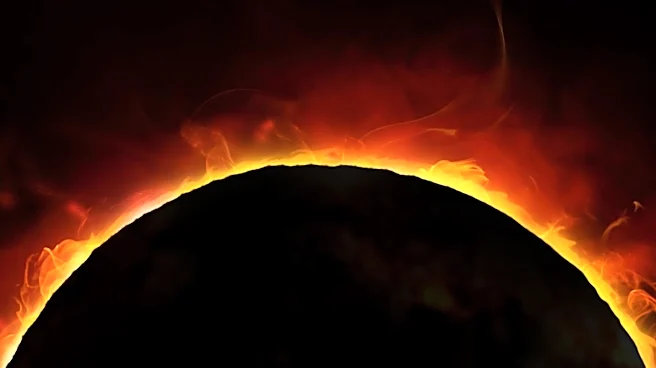








The solar eclipse of June 24, 1778, stands out as a significant astronomical event in history. This total solar eclipse was not only a spectacle of nature but also a moment of scientific observation and cultural impact. It was visible across parts of New Spain, the southeastern United States, and northern Africa, offering a rare opportunity for observers of the time to witness the moon completely obscuring the sun.
The Path of Totality
On June 24, 1778, the path of totality
for the solar eclipse stretched across New Spain, which includes parts of present-day Mexico, and the southeastern United States, before ending in northern Africa. This path allowed a wide range of observers to experience the eclipse in its totality. The eclipse lasted for 5 minutes and 52 seconds at its peak, providing a substantial window for observation.
The eclipse was part of Saros series 133, a series of eclipses that repeat every 18 years and 11 days. This particular series includes 72 events, with the 1778 eclipse being the 32nd in the sequence. The series began with a partial eclipse in 1219 and will conclude with another partial eclipse in 2499. The 1778 eclipse was notable for its magnitude of 1.0746, indicating that the moon's apparent diameter was significantly larger than the sun's, allowing for a complete blockage of sunlight.
Observations and Documentation
The 1778 eclipse was the first total solar eclipse recorded in the United States. Notable figures such as Thomas Jefferson documented their observations, despite some areas being clouded over. Jefferson, in Virginia, noted the cloudy conditions but shared his observations with Reverend James Madison in Williamsburg, where the conditions were clearer. Madison reported that the return of light was almost instantaneous, and the appearance of nature during the eclipse was awe-inspiring.
General George Rogers Clark and his men also observed the eclipse as they traveled during the Illinois Campaign, interpreting it as a favorable omen. U.S. troops in Georgia, on a mission to invade British East Florida, recorded the event as well. These observations highlight the widespread interest and significance of the eclipse across different regions and contexts.
The Role of Antonio de Ulloa
Antonio de Ulloa, a Spanish Navy officer and scientist, played a crucial role in documenting the 1778 eclipse. Ulloa observed the eclipse during his return voyage from Veracruz to Cádiz. His observations were later published, contributing to the scientific understanding of solar eclipses at the time. Ulloa's work exemplifies the intersection of scientific inquiry and exploration during the Enlightenment period.
The solar eclipse of June 24, 1778, remains a fascinating event in the annals of history. It not only provided a spectacle for those who witnessed it but also served as a catalyst for scientific observation and documentation. The eclipse's path across diverse regions and its documentation by notable figures underscore its historical and cultural significance.