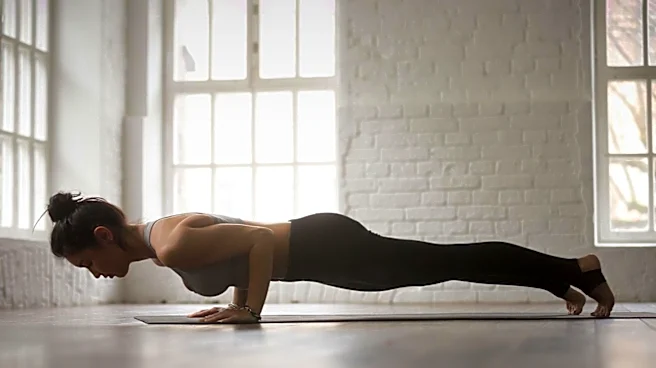

Chaturanga Dandasana, often referred to as Four-Limbed Staff Pose or Low Plank, is a fundamental asana in modern yoga as exercise. This posture is characterized by a straight body held parallel to the
ground, supported by the toes and palms, with the elbows bent at a right angle and kept close to the body. It is a powerful pose that builds strength and stability, serving as a transitional posture in many yoga sequences, particularly in forms like Surya Namaskar, or Salute to the Sun. The variation known as Kumbhakasana, Phalakasana, or High Plank, involves straight arms, offering a different level of intensity.
Etymology and Core Description of the Pose
The name Chaturanga Dandasana is derived from Sanskrit, with each component offering insight into the pose's structure. "Catur" means "four," "anga" translates to "limb," "danda" signifies "staff," and "asana" denotes "posture" or "seat." Thus, the name literally means "Four-Limbed Staff Pose," accurately describing the four points of contact (two hands and two feet) that support the body, which is held rigid like a staff.
In its execution, Chaturanga Dandasana closely resembles the low position of a push-up. However, a key distinction lies in the placement of the hands, which are positioned quite low, typically just above the pelvis. Crucially, the elbows are kept tucked in along the sides of the body, rather than flaring out. The body remains parallel to the floor and is lowered towards it, but ideally, it does not make contact. This precise alignment is essential for engaging the correct muscles and preventing strain, making it a challenging yet rewarding posture to master.
Chaturanga Dandasana in Surya Namaskar and Iyengar Yoga
Chaturanga Dandasana plays a vital role in the Surya Namaskar (Salute to the Sun) asana sequence within Ashtanga (vinyasa) yoga. In this dynamic flow, the pose is performed on an exhalation, linking breath with movement. It is specifically the fourth asana in Surya Namaskar A, and it appears multiple times—as the fourth, eighth, and twelfth asanas—in Surya Namaskar B. Its repeated inclusion highlights its importance in building core strength and preparing the body for subsequent postures in the sequence.
In contrast to the dynamic nature of Ashtanga, Iyengar Yoga approaches Chaturanga Dandasana with an emphasis on precise alignment and sustained holding. In Iyengar Yoga, the posture is typically held for a specific duration, such as 30 seconds, with continuous and controlled breathing. This method allows practitioners to deeply engage with the pose, focusing on the subtle nuances of alignment and muscle engagement. The sustained hold in Iyengar Yoga aims to cultivate strength, endurance, and a deeper understanding of the body's structure within the asana, differing from the transitional role it often plays in vinyasa styles.