







The Traditional Blueprint
Before Chris Sale, the term "power pitcher" conjured a specific image: broad-shouldered, thick-legged titans who overpowered hitters with brute force. Think of Roger Clemens, Nolan Ryan, or the 6-foot-10 Randy Johnson. Their power was visceral, a product
of imposing physical frames generating terrifying velocity. They weren't just pitchers; they were physical specimens who dared batters to catch up to their heat. This was the established archetype for dominance—be bigger, stronger, and throw harder than everyone else. The formula was simple and, for a long time, seemingly unbreakable. Teams scouted for these body types, and the mythology of the flame-throwing ace was built on this foundation of physical intimidation.
The Unlikely Prototype
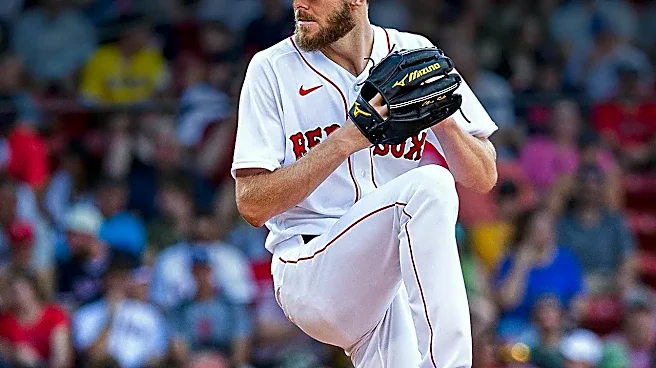
Then Chris Sale arrived. At 6-foot-6 but with a wiry build that seemed to defy the laws of power generation, he was an immediate visual paradox. He wasn't built like the power pitchers who came before him. Yet, the results were undeniable. From his early days with the Chicago White Sox, he produced elite velocity and some of the highest strikeout rates in the game. He became the fastest pitcher in history to reach 2,000 career strikeouts, doing so in just 1,626 innings. Sale proved that elite power wasn't exclusively the domain of the physically imposing. His success forced scouts, coaches, and fans to reconsider the very definition of a power arm, opening the door for pitchers of all body types to be seen as potential aces.
Violence and Deception in Motion
Sale's power wasn't born from muscle mass but from a uniquely violent and deceptive delivery. His mechanics are a contortionist's act of flailing limbs and extreme torque. With a low, almost sidearm release point and a cross-body motion, the ball seems to appear from behind a batter's back. This delivery, often described as an "inverted W" for the shape his arms make, creates incredible whip and arm speed, but also puts immense stress on his elbow and shoulder. The crown jewel of this chaotic delivery is his legendary slider. Thrown from that same deceptive arm slot, the pitch starts behind a right-handed hitter's hip before sweeping across the entire plate at high velocity, making it nearly impossible to hit. This combination of a frighteningly unorthodox delivery and an unhittable breaking ball became Sale's signature, a new form of power based on deception and extreme mechanics.
A Fragile Dominance
The same violent mechanics that made Sale a generational talent also made him susceptible to injury. His career has been marked by periods of breathtaking dominance followed by significant time on the injured list. After seven consecutive All-Star seasons to start his career as a starter, he faced a series of major setbacks, including Tommy John surgery in 2020, a stress fracture in his rib cage, and even a broken wrist from a bicycle accident. This fragility is the other side of the coin for his unique brand of power. While the old guard of power pitchers often battled injuries from sheer workload, Sale's issues seemed directly linked to the high-stress nature of his delivery. His career serves as a powerful case study in the trade-off between mechanical extremity and long-term durability, a conversation that now surrounds many modern hard-throwing pitchers.
The Legacy of a New Archetype
Despite the injuries, Sale's impact is undeniable. His success validated a different path to power, one built on kinetic energy and whip rather than raw strength. Pitchers with unconventional deliveries and lankier frames, who might have been overlooked in a previous era, are now viewed through a different lens. Players like Cooper Hjerpe are drawing comparisons to Sale for their similarly unorthodox arm angles and high strikeout potential. Sale’s career, especially his renaissance with the Atlanta Braves where he captured his first Cy Young Award in 2024, proved that his style could lead to the highest honors in the sport. He didn't just rack up strikeouts; he expanded the very idea of what a power pitcher could be, leaving a lasting mark on how the next generation of arms is developed and evaluated.