

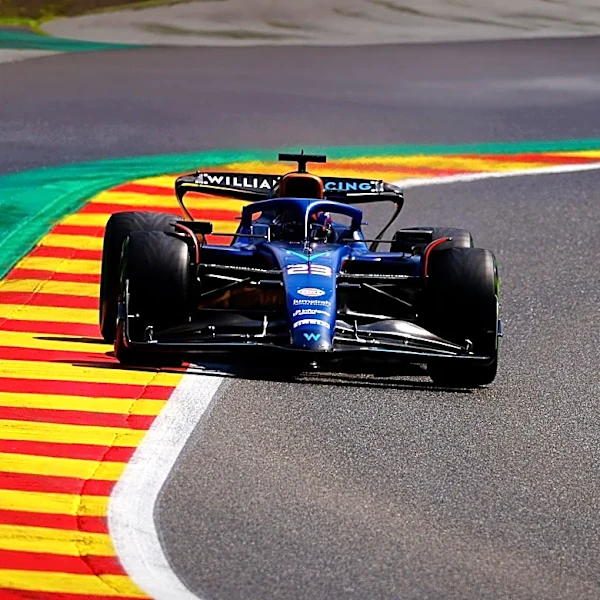



The Rollercoaster in the Dunes
Drivers often describe a lap of Zandvoort as a rollercoaster ride, and it’s not hard to see why. The track is defined by its dramatic elevation changes, swooping up and down through the natural landscape. Corners like Scheivlak (Turn 7) are a perfect
example of this brutal test. It’s a fast, downhill, blind right-hander where the track literally falls away from the car. Drivers have to commit fully, trusting their instincts and the car's grip as they plunge downward. This constant undulation challenges a driver's spatial awareness and their ability to feel the car's balance as it goes light over crests and compresses into dips. Unlike modern, flat circuits, Zandvoort demands a level of innate bravery and car control that can't be simulated; it has to be felt, corner after breathtaking corner.
Banking on the Edge
Zandvoort's most visually stunning features are its banked corners, which are steeper than those at the famed Indianapolis Motor Speedway. The Hugenholtzbocht (Turn 3) and Arie Luyendykbocht (Turn 14) feature aggressive banking of up to 19 and 18 degrees, respectively. This isn't just for show. The banking allows drivers to carry incredible speed through the corners, creating immense vertical and lateral G-forces that punish the car and driver, with some estimates suggesting forces of 5G to 6G. For the driver, this is a massive physical test, sustaining huge loads on their neck and body. But it's also a mental one. The banking opens up multiple racing lines, rewarding creativity but severely punishing any miscalculation. Getting it right feels like being slingshotted onto the next straight; getting it wrong can end a race instantly.
An Old-School Test of Precision
Perhaps the most intimidating aspect of Zandvoort is its old-school design philosophy. The track is narrow, and unlike many modern venues, it's not surrounded by acres of forgiving asphalt runoff. Instead, gravel traps and barriers lie just inches from the racing line. This means there is virtually no room for error. A small mistake that might cost a driver a few tenths at another track could mean a session-ending crash here. This unforgiving nature tests a driver’s precision and discipline to the absolute limit. It forces them to be perfect, lap after lap, under immense pressure. It also raises the stakes for overtaking, which is notoriously difficult on the narrow layout. Every move must be calculated and decisive, rewarding bravery but punishing recklessness.
The Unseen Challenges
Beyond the concrete and asphalt, Zandvoort throws other variables at the drivers. Its coastal location means the weather can change in an instant, and strong, gusty winds can dramatically affect the car’s aerodynamic balance. Another unique challenge is the sand that blows onto the track from the nearby dunes and beaches. This can drastically reduce grip levels, making the circuit unpredictable not just from day to day, but from one session to the next. Drivers must constantly adapt to a surface that is always evolving. This requires an incredible sensitivity and ability to read the conditions in real-time, a skill that separates the truly great drivers from the merely good ones. It's a test of adaptability, a crucial but often overlooked part of a driver's toolkit.