



A Rebel League's Grand Ambition
To understand Wrigley’s location, you first need to know about the Federal League. In 1914, this upstart league declared itself a third major league, aiming to compete directly with the established National and American Leagues. Its strategy was simple:
place teams in big-league cities and lure away star players. A key figure in this rebellion was Charles Weeghman, a successful Chicago restaurateur. Weeghman owned the city’s Federal League franchise, first known as the Chicago Federals or "Chi-Feds," and later as the Chicago Whales. To be a credible threat, Weeghman knew he needed a modern ballpark in a prime location, a direct challenge to the Chicago Cubs, who played at the wooden West Side Park.
Location, Location, Transportation
The corner of Clark and Addison streets was not a random choice. In the early 1910s, the plot was home to the Chicago Lutheran Theological Seminary. More importantly, it was perfectly situated in the growing Lake View neighborhood, which had been annexed into Chicago in 1889. The area was already a bustling residential and commercial zone. Critically, it was well-served by public transportation, particularly the city’s elevated train lines, making it easily accessible for fans from across the city. Weeghman understood that convenience was key to drawing crowds away from the established Cubs. He secured a lease on the property and, in a remarkably short time, began construction on his new steel-and-concrete ballpark, designed by architect Zachary Taylor Davis, who had also designed Comiskey Park.
The Short Life of Weeghman Park
Construction began on March 4, 1914, and Weeghman Park opened just weeks later on April 23, 1914, at a cost of about $250,000. It was an immediate success, featuring a single-deck grandstand with a capacity of 14,000 that was designed for an intimate fan experience. For two seasons, it was the home of the Chicago Whales. The team was competitive, even winning the Federal League pennant in 1915. However, the league itself was not financially sustainable. After a costly legal battle with organized baseball, the Federal League folded following the 1915 season.
From Whales to Cubs
The Federal League's demise created a unique opportunity. As part of the peace settlement, Weeghman was allowed to purchase a major league team. He assembled a group of investors, including chewing gum magnate William Wrigley Jr., and bought the Chicago Cubs from Charles P. Taft. Weeghman immediately moved his new team from their aging West Side Park to his two-year-old modern ballpark on the North Side for the 1916 season. The superior location and state-of-the-art facility made it an obvious upgrade. Thus, the ballpark built for a rebel team became the new home of the very franchise it was created to compete against.
The Wrigley Legacy Solidifies
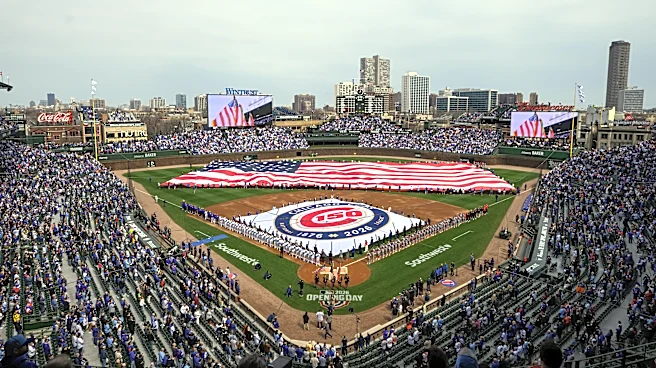
Weeghman’s control of the Cubs was short-lived. His finances faltered, and by 1918, he had sold his shares to William Wrigley Jr., who became the majority owner. The park was renamed Cubs Park in 1920 and, finally, Wrigley Field in 1926. Under Wrigley’s ownership, the park underwent the expansions that made it the icon it is today. The upper deck was added, and in 1937, Bill Veeck planted the now-famous ivy on the outfield walls and installed the hand-turned scoreboard. These additions cemented the ballpark's character, but the fundamental decision that placed it in a vibrant city neighborhood was made by Charles Weeghman, a man whose rival league failed but whose vision for a fan-friendly urban ballpark triumphed.