





The Unmatched Allure of the Workhorse
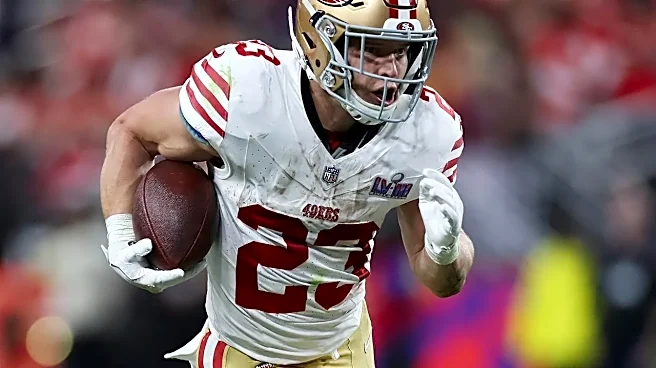
When he’s on the field, Christian McCaffrey is a fantasy football cheat code. After an injury-plagued 2024 season, he returned with a vengeance in 2025, playing in all 17 games and reminding everyone why he’s a perennial 1.01 candidate. He racked up 1,202
rushing yards, 924 receiving yards on 102 catches, and found the end zone a staggering 17 times. His total of 413 touches led all active running backs. This is the upside you dream of with the first pick: a player who is his team's offensive engine, combining elite rushing volume with the receiving prowess of a top wideout. He single-handedly offers the production of two players, creating a weekly advantage that is incredibly difficult for opponents to overcome. This level of dominance, which saw him win Comeback Player of the Year and earn First-Team All-Pro honors, is precisely what makes managers salivate at the prospect of building their roster around him.
The Inevitable Cost of Volume
However, with great volume comes great risk. McCaffrey’s value is tied directly to a workload that history shows is difficult to sustain. His 2025 season was remarkable for his durability, but it stands in contrast to a concerning injury history. Between 2020 and 2024, a series of ankle, shoulder, hamstring, and Achilles issues limited him significantly, including a 2024 season where he played in just four games. While some injuries were freak occurrences, the pattern is undeniable: heavy usage correlates with a higher chance of breaking down. His 311 carries in 2025 were the second-most among running backs, and his target share was among the league's highest. This isn’t a question of McCaffrey being “injury-prone,” but a matter of simple probability. The more a player is hit, the more chances there are for an injury to occur. At 30 years old, and with the 49ers already signaling a more cautious approach for 2026, drafting him at 1.01 means accepting this significant risk from the outset.
Is the Workhorse RB a Dying Breed at 1.01?
The conundrum with McCaffrey reflects a broader shift in the NFL and fantasy football. The era of the 400-touch running back is dwindling as teams increasingly turn to committees to keep their players fresh. This has changed the calculus for the first overall pick. In 2026 drafts, the conversation at 1.01 has diversified. Elite young running backs in more balanced systems, like Detroit's Jahmyr Gibbs and Atlanta's Bijan Robinson, are now top contenders. Both have shown incredible efficiency and upside without shouldering the entirety of their backfield's workload. Furthermore, the argument for taking a truly elite wide receiver like Ja'Marr Chase or Puka Nacua is stronger than ever. Wide receivers historically have a better track record of staying healthy and providing consistent, elite production year-over-year compared to their running back counterparts. The days of automatically locking in a workhorse back at 1.01 are over; the modern approach is about weighing stability against explosive, but fragile, potential.
The New 1.01 Philosophy: Mitigating Risk
So, what does McCaffrey teach us? He teaches us that the first pick isn't about drafting the player with the highest theoretical ceiling, but the one who offers the best blend of production and probability. Investing the most valuable draft capital in a player archetype that carries the highest injury risk is a bold, and perhaps unnecessary, gamble. While a healthy McCaffrey can absolutely win you a league, an injured one can sink your season before it even gets going. The lesson is to re-evaluate your tolerance for risk. Does it make more sense to secure a top-tier receiver who is a safer bet to play 17 games? Or perhaps a dynamic running back whose team is committed to managing their touches? The 1.01 pick should be a foundation for your team, not a weekly source of anxiety. The best ability, as the old saying goes, is availability—a lesson that the modern fantasy manager must take to heart when on the clock with the first pick.