



Embrace the Banking
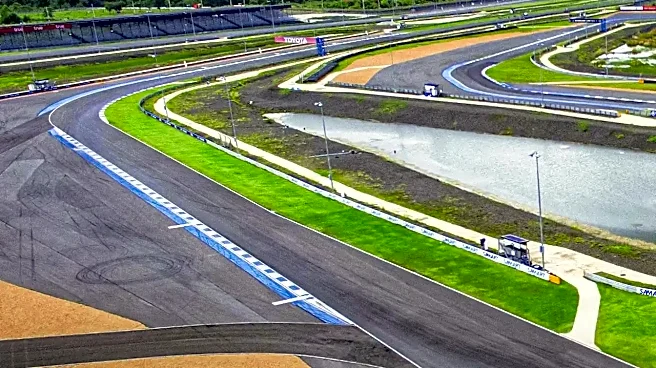
Zandvoort's most defining modern features are its banked corners, specifically Turn 3 (Hugenholtzbocht) and Turn 14 (Arie Luyendykbocht). Unlike a flat corner, this banking—with gradients up to 19 degrees—allows you to carry significantly more speed.
The skill here is trust and commitment. Drivers must learn to lean on the banking, allowing the corner's geometry to generate grip. It feels unnatural at first, as the vertical load on the tires increases dramatically, but fighting that instinct and maintaining throttle is key. A smooth, confident approach allows the car to compress into the banking and slingshot onto the following straight, making it a critical skill for a fast lap.
Mastering Blind Faith
The circuit’s layout, winding through natural dunes, creates numerous blind and semi-blind corners. Corners like Scheivlak (Turn 7) involve turning in without a clear view of the apex or exit. Mastering these sections requires immense confidence and track knowledge. You can't rely solely on what you see; you have to know where the track is going. The skill is to pick your turn-in points from distant markers and trust your line. You commit to the corner based on memory and peripheral cues, letting the car flow over the crest, confident that the track will be there to meet you on the other side. Hesitation means scrubbing speed, while misplaced confidence can send you into the gravel.
Precision Braking for the Tarzan Hairpin
The first corner, Tarzanbocht, is a legendary 180-degree hairpin and one of the circuit's prime overtaking opportunities. Coming off the long main straight, the braking zone is immense. The skill is not just braking late, but braking effectively while setting up for one of the multiple available lines. The corner's wide entry allows for different approaches, from a classic late apex to a defensive inside line. Trail braking—maintaining light brake pressure as you begin to turn—is essential here to keep the car's nose planted and help it rotate through the long hairpin, all while being prepared for a potential dive-bomb from a competitor.
Respect the Lack of Runoff
Zandvoort is often called an "old-school" circuit for a reason: mistakes are punished. Unlike many modern tracks with vast asphalt runoff areas, much of Zandvoort is lined with grass and deep gravel traps. The essential skill here is precision and discipline. You have to use every inch of the track, but not a centimeter more. Riding the curbs is necessary for a good lap time, but getting too aggressive can unsettle the car or, worse, send you into the gravel, ending your race. This constant, high-stakes environment requires a driver to be consistently on the absolute limit without overstepping it, a mental and technical challenge that defines a lap at Zandvoort.
Find the Flow and Rhythm
Zandvoort is not a stop-and-go circuit; it’s a track that demands rhythm. The middle sector, with its series of medium and high-speed esses, is all about flow. The key skill is to link these corners together with smooth, progressive inputs on the steering and throttle. A small mistake in one corner compromises the entry for the next two. Drivers must think several corners ahead, positioning the car on exit to perfectly set up the entry for the subsequent turn. Maintaining momentum is paramount. It’s a delicate dance where being overly aggressive breaks the car's rhythm and costs significant time, while being too timid means losing precious speed through its most flowing sections.