







A New Polygon in Town
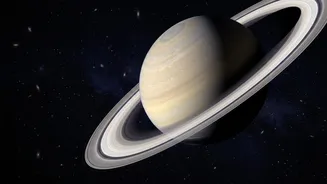
The latest view from the Hubble Space Telescope reveals a giant, evolving, 10-sided atmospheric wave encircling Saturn's south pole. Dubbed a 'decagon', this is the first time a large, regular-sided pattern has been observed in the planet's southern hemisphere.
For more than 40 years, scientists have been captivated by the stable, six-sided hexagon at the north pole. This new ten-sided feature presents a fascinating counterpart, giving scientists a rare opportunity to watch a massive planetary weather pattern develop in real time. The discovery was a collaborative effort, first hinted at in images from ground-based amateur astronomers in 2024 before being confirmed and studied in detail by Hubble's powerful eye.
The View from Hubble's OPAL
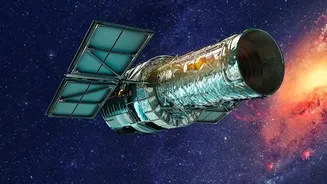
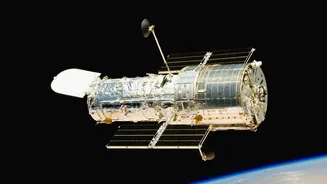
This discovery was made possible by Hubble’s Outer Planet Atmospheres Legacy (OPAL) program, which has been capturing annual images of our solar system's outer planets for over a decade. By reviewing this treasure trove of data, researchers were able to trace the decagon's origins back to 2023, when faint hints of the structure first began to appear. Hubble’s position in space, free from the blurring effects of Earth’s atmosphere, provides an unmatched sharpness that allows astronomers to see such detailed features. The telescope's multi-wavelength imaging also showed that the decagon is not just a surface-level cloud pattern; it's a vertically extended structure that reaches deep into Saturn's atmosphere.
A Tale of Two Poles
For years, scientists wondered why the northern hexagon didn't seem to have a southern twin. NASA's Cassini spacecraft, which orbited Saturn from 2004 to 2017, saw no evidence of a long-lasting polygon at the south pole. The sudden appearance of the decagon now raises new questions. Is it a temporary feature, or will it stabilize into a long-lived pattern like its northern sibling? The northern hexagon is thought to be a product of a jet stream bent into a geometric shape by atmospheric waves. The decagon appears to be located within a similar jet stream, but its rapid formation and different shape suggest its origin story may be unique.
Why This Cosmic Geometry Matters
Studying these giant polar vortices helps scientists understand the complex physics that govern the atmospheres of gas giants. Features like Jupiter’s Great Red Spot and Saturn’s hexagon give the impression of unchanging worlds, but the new decagon proves these planets are dynamic and constantly evolving. By observing how this 10-sided wave formed and how it changes over time, researchers can test and refine their computer models of planetary atmospheres. This knowledge doesn't just apply to Saturn; it provides crucial insights into the weather systems of gas giants throughout our solar system and beyond. Scientists will continue to use both Hubble and the James Webb Space Telescope to monitor the feature, hoping to unlock the secrets of its formation and future.