









A First for Tamil Nadu
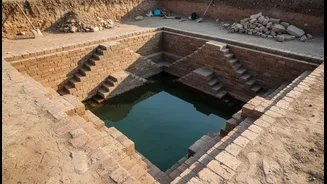
Archaeologists from the Tamil Nadu State Department of Archaeology have unearthed what they believe is the first-ever brick stepwell from the early historic period found in the state. The significant find was made at Karivalamvandanallur, near Tenkasi,
during one of eight state-sponsored excavations currently underway. For the past three months, researchers have been carefully digging near the Vaiparu riverbed, revealing not just the well but also distinct areas for habitation and a crematorium, painting a fuller picture of ancient life. This discovery adds a new dimension to our understanding of the Sangam Age, a period of rich cultural and literary history in South India.
Built to Last with Brick and Stone
The structure itself is a marvel of early engineering. Measuring four by four metres, the stepwell features stone steps descending into a well lined with brick walls. The bricks are of a specific size—40cm long, 20cm wide, and 7cm thick—which is consistent with those found at other major Sangam-era sites like Keeladi, Alagankulam, and Poompuhar. This consistency helps archaeologists confidently date the structure to the same period, roughly 2,500 years ago. The builders used an interlocking pattern for the bricks and clay as a binding material, creating a durable structure. Noticeable wear and tear on the stone steps indicate that the well was in use for a very long time, serving as a vital community resource.
A Hub of Ancient Life and Trade
The location of the stepwell is just as significant as its construction. Karivalamvandanallur is situated along a known ancient trade route that connected the city of Madurai to the west coast through the Shencottah pass. This is supported by the fact that Roman gold coins were discovered in the same area back in the 1930s. The recent excavation has also yielded other valuable artefacts, including high-tin bronze objects, iron implements, terracotta figurines, and glass beads. The presence of iron slag suggests there was an iron production centre nearby. Together, these finds suggest the area was a bustling hub of activity, with advanced knowledge of water management, metallurgy, and active participation in trade networks.
More Than Just a Water Source
Stepwells, known by various names like 'vav' or 'baoli' in other parts of India, were far more than utilitarian structures. They were integral to community life, serving as cool retreats from the heat and as gathering places for social and religious ceremonies. These architectural marvels were designed to provide access to groundwater year-round, a crucial innovation in regions with seasonal rainfall. While many stepwells in western India are famously ornate, this Sangam-era brick well in Tamil Nadu provides a different, yet equally important, perspective on the evolution of water architecture in the subcontinent. Its primary function was likely to tap into the high water table of the nearby river's paleochannel, especially during dry summer months.
What Happens Next?
The discovery of the stepwell has generated considerable excitement among historians and archaeologists. Excavation director V. P. Yathees Kumar noted that the team has dug to a depth of two metres and will continue to excavate to determine the well's full depth. The find is part of a broader effort by the Tamil Nadu government to explore its rich archaeological heritage, with ongoing excavations at multiple sites. Discoveries like this one, and the extensive urban settlement found at Keeladi, continue to push back the timeline of advanced civilization and literacy in the Tamil region, suggesting that large, organized urban centres were flourishing in the 6th century BCE. Each new find adds another piece to the puzzle of India's complex and fascinating past.