





A Cosmic Mapmaker with a Difference
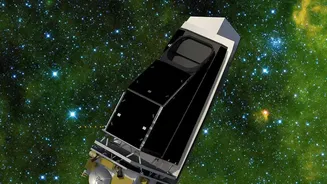
Imagine trying to create a map of every city on Earth, not just by plotting their locations, but by also capturing the unique signature of each one. That, in essence, is what the Spectro-Photometer for the History of the Universe, Epoch of Reionization,
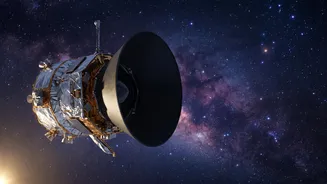
and Ices Explorer—or SPHEREx—is doing for the cosmos. Launched in March 2025, this observatory is conducting the first-ever all-sky survey in near-infrared light, which is invisible to the human eye. During its two-year mission, SPHEREx will scan the entire sky four times, collecting data on hundreds of millions of galaxies and over 100 million stars in our own Milky Way. Unlike telescopes that focus on specific targets, SPHEREx is a wide-field surveyor, creating a massive, comprehensive dataset that will serve as a rich archive for astronomers worldwide for years to come.
Probing the Universe's First Second
One of the mission's most ambitious goals is to find clues about a phenomenon known as cosmic inflation. This is the theory that in the very first fraction of a second after the Big Bang, the universe expanded exponentially, a trillion-trillion-fold in an instant. This event left a subtle imprint on the large-scale distribution of matter we see today. By precisely mapping the positions of hundreds of millions of galaxies, SPHEREx will create a 3D model of the universe's structure. Scientists can then analyze this structure for patterns predicted by different models of inflation. Understanding how inflation happened is one of the biggest challenges in modern cosmology, and SPHEREx's data will provide crucial evidence to test competing theories about what powered the 'bang' in the Big Bang.
Tracing the History of Starlight
The universe is filled with light, but much of it comes from sources that are too faint or diffuse for many telescopes to see individually. SPHEREx will measure the collective glow of all galaxies, both near and far, creating a history of light production throughout the cosmos. By studying this background glow, scientists can understand how galaxies formed and evolved over billions of years, even accounting for the light from hidden or faint galaxies that other surveys might miss. This provides a more complete census of cosmic star formation, tracing the story of how the dark universe first began to light up with stars and galaxies.
A Hunt for Life's Ingredients
Closer to home, SPHEREx is conducting a unique chemical survey within our own Milky Way galaxy. It is searching for the building blocks of life—specifically water ice and organic molecules—in the places where new stars and planets are born. These molecules are frozen onto dust grains within vast, cold clouds of gas and dust. When these clouds collapse to form stars and planetary systems, these ices can become incorporated into newborn planets and comets. By measuring how much of these life-essential ingredients are present and where they are located, SPHEREx will help us understand the prevalence of water in the galaxy and whether the raw materials for life are common or rare in newly forming solar systems.
How SPHEREx Sees the Universe
The key to the mission's power is a technique called spectroscopy. Just as a prism splits sunlight into a rainbow, SPHEREx breaks down the near-infrared light from every point in the sky into its component wavelengths, or colours. It will map the sky in 102 different infrared colours, far more than any previous all-sky survey. These 'colour signatures' act like cosmic fingerprints, revealing an object’s chemical composition and its distance from us. This ability to capture a spectrum for everything it sees is what makes the SPHEREx map so uniquely powerful, turning a flat image of the sky into a rich, multi-dimensional database of the cosmos.