




Meet the Ghost Particle
Neutrinos are fundamental particles, but they are notoriously antisocial. They are incredibly tiny, have almost no mass, and carry no electrical charge. This means they are not affected by the magnetic fields that bend the paths of other particles, like
cosmic rays. They sail through planets, stars, and entire galaxies without interacting with anything, earning them the nickname 'ghost particles'. While this makes them perfect messengers, carrying information straight from their source, it also makes them incredibly difficult to detect. Gigantic detectors, like the IceCube Neutrino Observatory buried in a cubic kilometre of Antarctic ice, are needed to spot the rare instance when a high-energy neutrino smashes into an atom.
Hunting the Cosmic Engines
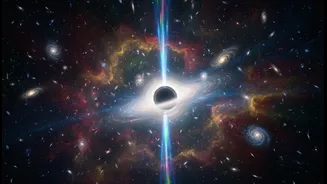
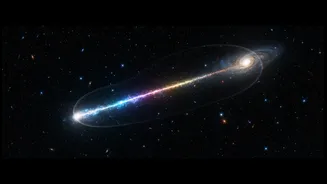
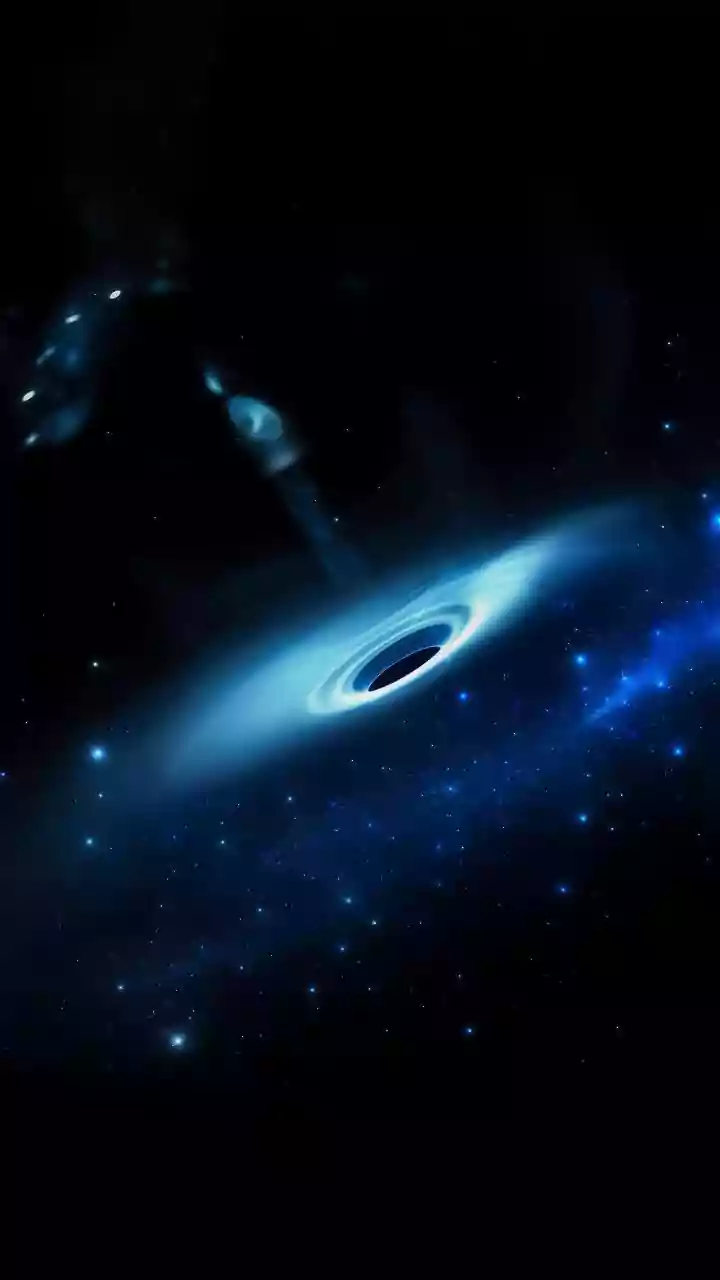
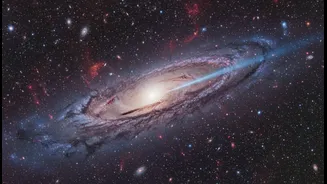
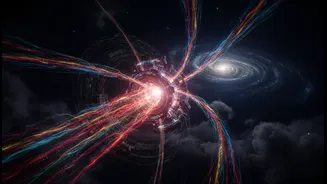
For decades, a major puzzle in astrophysics has been the origin of ultra-high-energy cosmic rays, which are particles accelerated to incredible speeds. The headline’s “Shadow Blaster” is a colourful term for the likely culprits: blazars. A blazar is a type of active galactic nucleus (AGN), a galaxy with a supermassive black hole at its centre that is actively feeding on surrounding gas and dust. As the black hole consumes matter, it blasts out colossal jets of energy and particles in opposite directions at nearly the speed of light. When one of these jets happens to be pointed directly at Earth, we see it as a blazar. These are among the most powerful particle accelerators in the universe.
The Cosmic Ray Connection
Scientists have long suspected that blazars are the engines that create the most energetic cosmic rays. The problem is that cosmic rays are charged particles, so their paths get scrambled by magnetic fields as they travel across the universe, making it impossible to trace them back to their origin. Neutrinos, however, are the smoking gun. Since they travel in straight lines, detecting a high-energy neutrino coming from the direction of a known blazar provides powerful evidence that these objects are indeed accelerating cosmic rays. In 2017, the IceCube observatory detected a high-energy neutrino and alerted astronomers worldwide, who then saw a flare from a blazar named TXS 0506+056 in the same patch of sky, marking a historic first in identifying a specific source.
A Window into Galaxy Evolution
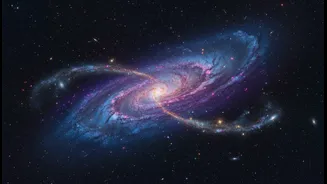
Understanding these powerful cosmic events does more than just solve the cosmic ray mystery. The immense energy and outflow of particles from active galactic nuclei, like blazars, can have a profound impact on their host galaxies. This outflow can heat up or blow away the gas needed to form new stars, effectively regulating or even halting star formation across the entire galaxy. By studying neutrinos from these sources, astronomers gain a new tool to probe the extreme physics happening deep within these active galaxies, processes that are often hidden from traditional telescopes that rely on light. This helps refine our models of how galaxies grow, change, and interact with the supermassive black holes at their cores over cosmic time.
The Dawn of Multi-Messenger Astronomy
This breakthrough is a cornerstone of an exciting new field called multi-messenger astronomy. The idea is to combine information from different cosmic 'messengers'—light (photons), gravitational waves (ripples in spacetime), cosmic rays, and neutrinos—to get a complete picture of a single cosmic event. Each messenger provides a unique perspective. Light shows us the hot, energetic plasma, while gravitational waves reveal the movement of immense masses like merging black holes. Neutrinos, on the other hand, offer a direct glimpse into the nuclear processes happening at the very heart of these cosmic engines, where light cannot escape. Observing an event like a flaring blazar with all these messengers at once is like finally getting sound and subtitles for a silent movie, revealing the full story.