






What is Microgravity, Really?
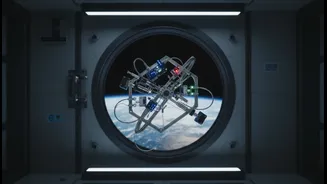
First, let's clear up a common misconception. There is no place in space with absolute 'zero gravity'. Gravity is everywhere, but its effects can be significantly reduced. Microgravity is the condition where objects are in a state of constant freefall.
Imagine being in an elevator when the cable snaps—for those few terrifying seconds before it hits the ground, you and everything else inside would be floating weightlessly. Astronauts in orbit are doing the same thing. They, their spacecraft, and everything inside are constantly 'falling' around the Earth at such a high speed that they never actually hit it, creating a sustained environment of near-weightlessness. This tiny, or 'micro', gravitational force is what gives the condition its name and makes it a one-of-a-kind laboratory.
Why Bother Studying It?
Without the dominant force of gravity pulling things down, the fundamental rules of physics and biology change. Fluids mix differently, flames burn in spheres, and crystals can grow to a level of purity impossible on Earth. For ISRO, this is a golden opportunity. By studying these changes, scientists can make breakthroughs in material science, developing new alloys and medicines. In biology, microgravity helps researchers understand how human cells behave without gravity's influence, offering new insights into muscle atrophy, bone density loss, and disease progression like cancer. This research is not just for future astronauts on long-duration missions; it has direct applications for treating diseases back on Earth.
Creating 'Space' on Earth
Before sending an expensive experiment into orbit, scientists need to test it. ISRO, like other major space agencies, uses ground-based facilities to simulate microgravity for short periods. One key method is the use of drop towers. These are tall structures where an experimental payload is dropped in a vacuum or drag-resistant chamber, allowing it to experience a few seconds of pure freefall. Another technique involves parabolic flights, where a large aircraft performs a series of steep climbs and dives. During the top of this arc-like path, passengers and equipment inside experience about 20-25 seconds of microgravity, which is why these planes are often nicknamed 'vomit comets'. These methods provide crucial, cost-effective testing windows for hardware and experimental procedures.
The Ultimate Lab: Research in Orbit
While simulations are useful, the best place for microgravity research is space itself. ISRO is increasingly leveraging orbital platforms for this. For instance, the final stage of the PSLV rocket, once its main job is done, is sometimes used as an orbital platform (called POEM) for experiments. More significantly, ISRO is designing experiments for crewed missions. As part of collaborations for the upcoming Gaganyaan mission, Indian scientists have designed experiments conducted on the International Space Station (ISS). These have included studies on how microgravity affects the growth of nutrient-rich Indian staples like moong beans, human-computer interaction, and the regeneration of muscle cells. This hands-on experience is vital for building India’s capacity for complex space science.
The Future of Indian Microgravity Science
This research is a cornerstone of India's ambitious space agenda. The experiments conducted by Indian astronauts and on ISRO platforms are not just standalone studies; they are building blocks for future long-duration missions. The insights gained into life support systems, food production, and astronaut health are critical for the success of Gaganyaan and the planned Bharatiya Antariksh Station (Indian Space Station), which is expected to be operational by 2035. Through its IMEx-2026 programme, ISRO is also actively inviting the national research community from labs, universities, and even startups to develop new experiments, fostering a robust ecosystem for space science in the country.