




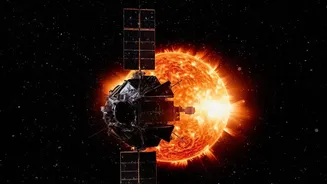
The Sun's Gigantic Eruptions
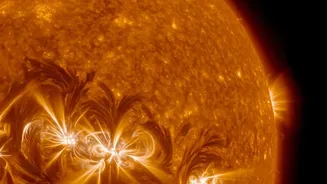
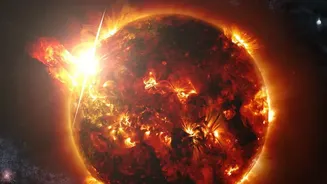
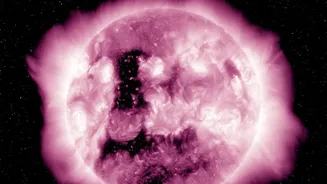
Our Sun, the life-giving star at the center of our solar system, is not always calm and steady. It occasionally produces massive explosions of plasma and magnetic fields known as Coronal Mass Ejections, or CMEs. These are not small events; a single CME can
involve billions of tonnes of solar material erupting into space, traveling at speeds of up to several million kilometres per hour. CMEs are born from the Sun's complex and ever-shifting magnetic fields. When these magnetic field lines become tangled and stressed, they can suddenly snap and reconnect, violently flinging plasma out into space. While the Sun ejects CMEs in all directions, the ones that are aimed toward Earth pose a significant threat to our increasingly technology-dependent world.
Why CMEs Are a Threat
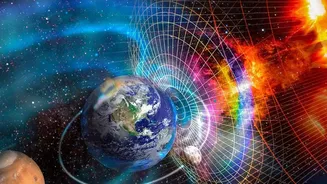
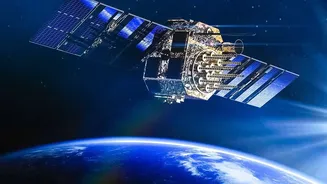
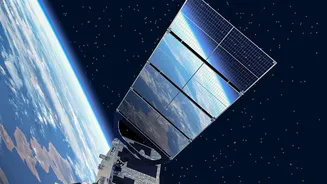
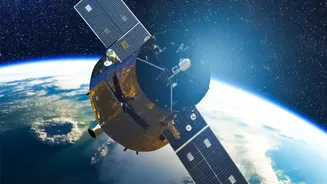
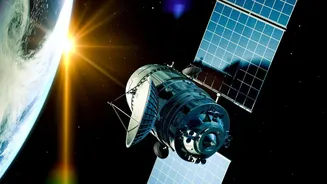
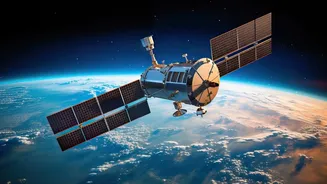
When an Earth-directed CME ploughs through space, it carries its own powerful magnetic field. If this cosmic cloud of charged particles collides with Earth's magnetosphere—our planet's natural magnetic shield—it can cause a major disturbance known as a geomagnetic storm. These storms can have serious consequences. They can induce powerful electrical currents in long conductors like power grids, potentially leading to widespread blackouts. In space, they are particularly dangerous for satellites. The energetic particles can damage sensitive electronics, disrupt communications, degrade GPS accuracy, and even expose astronauts to harmful radiation. The smooth functioning of everything from DTH television and airline navigation to online financial transactions relies on this space-based infrastructure being protected.
The Digital Crystal Ball: How Models Work
To prevent catastrophic failures, we need advance warning. This is where sophisticated computer models come in. Forecasters at agencies like the US-based Space Weather Prediction Center (SWPC) use a system called WSA-Enlil. This model works in two stages. First, data from solar observatories is used to create a map of the Sun's magnetic field and estimate the baseline solar wind conditions. When satellites like the Solar and Heliospheric Observatory (SOHO) detect a CME erupting from the Sun, forecasters input its initial characteristics—speed, direction, and size—into the Enlil part of the model. Enlil, a complex 3D magnetohydrodynamic model, then simulates the CME's journey through the 150 million kilometres of interplanetary space, predicting its arrival time at Earth and its potential intensity, providing a crucial 1-4 day warning.
From Prediction to Action
This advance warning is critical for satellite operators. With a forecast in hand, they can take protective measures. This might involve temporarily shutting down non-essential systems, reorienting the spacecraft to shield its most sensitive components, or delaying critical manoeuvres until the storm has passed. While the models provide a window of several days, the final, most immediate confirmation comes from satellites positioned at a special gravitational balance point called Lagrange Point 1 (L1), about 1.5 million km from Earth. Spacecraft like the DSCOVR satellite and India's Aditya-L1 sit at this location, acting as a cosmic tripwire. When the CME's shockwave hits them, they provide a final, high-fidelity warning anywhere from 15 to 60 minutes before the storm impacts Earth's immediate environment.
India’s Eye on the Sun
India has significantly bolstered its role in global space weather monitoring with the Aditya-L1 mission. Launched by ISRO, this state-of-the-art observatory is strategically placed in a halo orbit around the L1 point, granting it a continuous, uninterrupted view of the Sun. Aditya-L1 is equipped with seven distinct payloads designed to study the Sun's atmosphere, solar eruptions, and the solar wind. Its instruments observe the initiation of CMEs and provide crucial data on their characteristics. By observing the storm as it passes L1, it provides vital in-situ data that helps refine impact assessments for Earth. The mission is a cornerstone of India's efforts to develop its own robust space weather prediction capabilities, contributing critical knowledge to the international scientific community and helping to safeguard our nation's vital space assets.