





The Challenge of the First Sighting
Detecting a new Near-Earth Object (NEO) is a monumental task. It begins when a telescope, scanning a patch of sky, captures a faint point of light moving against the backdrop of fixed stars. Astronomers compare multiple images of the same region, taken
minutes apart, to spot these moving targets. Once a potential NEO is flagged, its position is reported to the Minor Planet Center, the global clearinghouse for such data. This initial set of observations is the foundation upon which everything else is built. From these first few data points, scientists at organisations like ESA's Near-Earth Object Coordination Centre (NEOCC) must calculate a preliminary orbit. This initial calculation is a race against time, trying to predict where the object is heading and whether it poses any threat to Earth.
What Makes an Observation 'Poor'?
Not all observations are created equal. A 'poor-quality' observation can result from numerous factors. Atmospheric turbulence can distort the image, making the asteroid's position slightly blurry or uncertain. The equipment itself, from amateur telescopes to professional surveys, has varying levels of precision. Even the number and timing of the observations play a huge role; a few data points clustered over a short period provide a much less reliable trajectory than observations spread out over several nights. This initial dataset might contain what scientists call 'noise' or errors in the measurements of the asteroid's precise location (astrometry) at a specific time. Think of it like trying to guess the destination of a train by seeing it for only a split second through a foggy window.
How Small Errors Create Big Problems
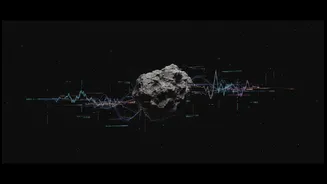
The principle of 'garbage in, garbage out' is especially true for orbital mechanics. A tiny inaccuracy in an asteroid's initial observed position can be magnified enormously when projected weeks, months, or years into the future. An orbit is calculated by fitting a curve to these observational data points. If the points themselves are slightly off, the entire predicted path can be wrong. This creates a large 'uncertainty region'—a cone of possible future locations for the asteroid. A small error might mean the difference between an asteroid being predicted to safely miss Earth by millions of kilometres and one that appears to have a chance, however small, of impact. This is why initial risk assessments for newly discovered asteroids can sometimes seem alarming, only to be revised downward as more and better data becomes available.
ESA’s Toolkit on the Front Line
To manage this uncertainty, ESA's NEOCC uses a sophisticated suite of automated systems, including 'Aegis' and 'Meerkat'. These tools continuously ingest new observation data, recalculate orbits, and assess impact probabilities for the next 100 years. The NEO Toolkit, available to the public, allows anyone to visualise these orbits and potential flybys. However, these powerful tools are fundamentally limited by the quality of the data they receive. If the initial observations are poor, even the most advanced software will produce a wide range of possible trajectories. The system is designed to work with this uncertainty, constantly updating risk assessments as more observations come in from telescopes around the world to refine the orbit. Recently, ESA even released new tools to help analyse observation quality and identify outliers, further strengthening this process.
Strengthening the First Line of Defence
The planetary defence community is actively working to minimise these initial errors. One approach is improving observation technology. New, more powerful survey telescopes like the Vera C. Rubin Observatory are coming online, promising to deliver vast amounts of higher-quality data. Another key strategy is rapid follow-up. Once a new object is detected, observatories around the globe are alerted to take more measurements as quickly as possible, extending the observational arc and shrinking the margin of error. Furthermore, both ESA and NASA are developing frameworks to standardise data quality assessment, ensuring that observations from different sources can be trusted and integrated effectively. By improving the quality and quantity of data from the very beginning, scientists can provide more accurate and reliable warnings, ensuring that our planetary defence system is built on the firmest possible foundation.