



A Glimpse into Cosmic Dawn
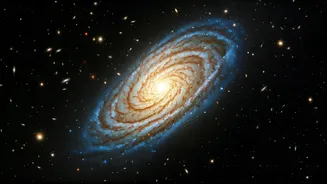
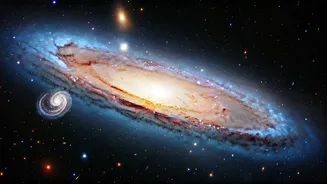
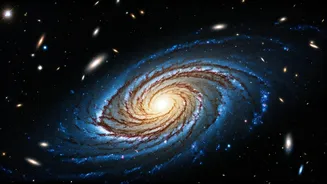
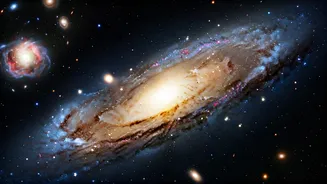
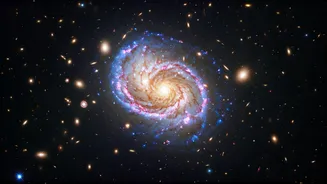
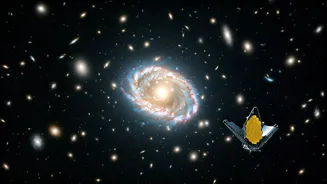
Using powerful instruments like the Atacama Large Millimeter/submillimeter Array (ALMA) and the James Webb Space Telescope (JWST), astronomers are peering into the universe's infancy. They are finding massive groups of galaxies, known as protoclusters,
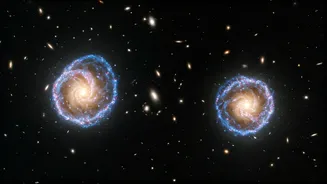
that existed when the universe was just a fraction of its current age. One such structure, SPT2349-56, was found brimming with galaxies just 1.4 billion years after the Big Bang. These aren't small, disorganized collections; they are sprawling, active cosmic cities where stars are forming at a furious pace, sometimes a thousand times faster than in our own Milky Way. The galaxies are so crowded that many are crashing into each other, a process that was thought to take much longer to become common.
The Standard Model Under Strain
This is where the trouble starts for our current understanding. The reigning theory of the universe's evolution is called the Lambda-Cold Dark Matter (ΛCDM) model. In simple terms, it's the recipe for how the universe grew from the Big Bang to what we see today. That model predicts a slow, hierarchical process where small structures form first and then gradually merge over billions of years to create larger ones like galaxy clusters. The discovery of well-established, massive clusters so early in cosmic history is like finding a skyscraper in a village that was supposed to be building mud huts. The observations suggest that the process of galaxy and cluster formation was happening much faster and more efficiently than predicted.
What is Lambda-CDM Anyway?
The Lambda-CDM model is the cornerstone of modern cosmology. The 'Lambda' (Λ) refers to dark energy, a mysterious force causing the universe to expand at an accelerating rate. 'Cold Dark Matter' (CDM) is a type of invisible matter that doesn't interact with light but exerts a powerful gravitational pull, forming the scaffold upon which galaxies and clusters are built. This model has been incredibly successful, explaining everything from the leftover glow of the Big Bang (the Cosmic Microwave Background) to the large-scale distribution of galaxies we see today. It works so well that it's often called the "Standard Model of Cosmology." But like any scientific theory, it's only as good as the evidence that supports it, and new, more powerful telescopes are putting it under unprecedented stress.
Not the First Cosmic Puzzle
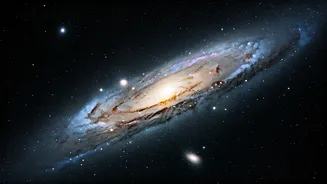
The word "Again" in the headline is key. This isn't the first time observations have created tension with the Standard Model. For years, cosmologists have grappled with the "Hubble Tension," a persistent disagreement between different methods of measuring the universe's expansion rate. There have also been questions about the abundance of certain light elements like Lithium and puzzles about the structure of nearby galaxies. These anomalies and tensions are signs that the Standard Model, while powerful, might be incomplete. Each new puzzle, like the existence of these early galaxy clusters, adds another piece to a picture that is becoming increasingly complex.
The Path Forward: New Physics or Better Models?
So, is cosmology broken? Not exactly. Most scientists see these challenges not as a crisis, but as an exciting opportunity. It's how science advances. The discoveries from JWST and other observatories don't necessarily mean the Big Bang was wrong, but they do indicate our story of what happened next needs some serious edits. Researchers are now exploring a wealth of new ideas. Did early black holes grow much faster than we thought, helping to build galaxies around them? Is there something about dark matter or dark energy we don't understand? Or do the models for star formation and feedback within early galaxies need a complete overhaul? The goal now is to gather more data, refine simulations, and test these new hypotheses.