
An AI Built for the Moon
The project is officially called the NASA-IBM Lunar Foundation Model. It is one of the first AI models built specifically for lunar science and has been made open-source, available to the global research community on the platform Hugging Face. Think of it as a highly
intelligent assistant for planetary scientists. Instead of researchers manually poring over petabytes of images and sensor readings, or building single-use algorithms, this 'foundation model' provides a powerful, pre-trained base that can be quickly adapted for many different tasks. It was trained on vast amounts of data, primarily from NASA’s Lunar Reconnaissance Orbiter (LRO), which has been mapping the Moon in high resolution for over 17 years.
The Hunt for Water Ice
One of the model's most critical tasks is to find water ice. For NASA's Artemis program, which aims to establish a long-term human presence on the Moon, water is a game-changing resource. It provides drinking water and breathable oxygen for astronauts, and its components can be split into hydrogen and oxygen for rocket fuel. This ice is believed to be trapped in permanently shadowed regions near the lunar poles, which are incredibly cold and difficult to observe. The AI model helps by analyzing data from multiple instruments to predict where ice is most likely to be stable, both on the surface and just below it, dramatically narrowing down the search area for future robotic and human missions.
Mapping Craters and Volcanic History
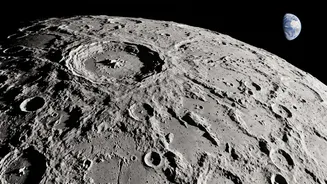
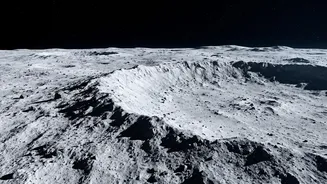
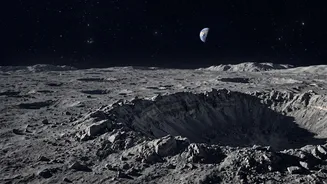
Beyond the search for ice, the model is a powerful tool for understanding the Moon's geology and history. It can map craters with an efficiency and scale that manual methods cannot match. Crater counts are essential for dating different parts of the lunar surface and reconstructing the history of impacts in our solar system. The AI can also identify subtle geological features, such as 'irregular mare patches'. These are unusual volcanic areas that appear relatively young, challenging existing theories about how long the Moon remained geologically active. By quickly mapping these features across the entire lunar surface, scientists can piece together a more accurate timeline of the Moon's evolution.
Planning a Safer Return
The model's capabilities have direct applications for mission planning. Accurate maps of craters and surface features help NASA select safe landing sites for spacecraft, avoiding hazards like steep slopes or large boulders. By understanding the landscape in greater detail, mission planners can better identify locations for long-term infrastructure, like habitats and research outposts. The AI essentially creates a unified, intelligent toolkit that transforms decades of disjointed data into actionable insights for the next wave of lunar exploration. For example, it can analyze before-and-after images to automatically detect new impact craters, like one formed by a SpaceX rocket body.
A New Era of AI-Powered Discovery
The Lunar Foundation Model is part of a broader strategy by NASA and IBM to apply AI to massive scientific datasets. This collaboration has already produced similar models for Earth science (Prithvi) and heliophysics (Surya), which help monitor disasters, predict crop yields, and track solar flares. By creating these foundational tools, the agencies are changing the workflow of scientific research. Instead of starting from scratch for every new question, scientists can adapt these powerful, pre-trained models, saving time and computational resources. This approach accelerates the pace of discovery, turning vast archives of data into new knowledge about our planet and the solar system.