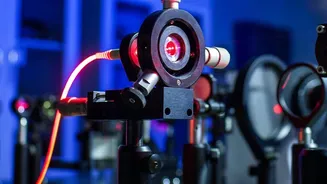







Why Quantum Needs the Big Chill
Quantum mechanics governs the weird and wonderful world of atoms and subatomic particles. Materials designed to leverage these properties could lead to incredibly powerful computers and hyper-secure communication networks. But there's a catch. The quantum
states that make this possible are incredibly fragile. At room temperature, the natural heat and vibrations of atoms create a storm of chaos that overwhelms these delicate effects. To keep these quantum properties stable, scientists have to cool materials down to temperatures near absolute zero (-273 degrees Celsius), which requires bulky, expensive, and energy-hungry cryogenic refrigeration systems. This single limitation has been the biggest barrier keeping quantum technology locked away in advanced labs rather than being used in everyday devices.
The Race to Beat the Heat
The holy grail of quantum physics is finding or creating materials that exhibit these properties at room temperature. Recently, scientists have made significant strides. In August 2026, researchers at Louisiana State University (LSU) announced they had created a material from a thin gold film that can sort and transport different quantum states of light at room temperature. This 'metacrystal' acts like a filter, directing quantum light along different paths without losing the information it carries, a task previously requiring extreme cold. In the same month, a team at UCLA found that boron arsenide, a crystalline semiconductor, can guide heat in focused, wave-like rays. This phenomenon, known as phonon focusing, had only ever been observed at cryogenic temperatures but can now be used at room temperature to route heat away from sensitive components in next-generation electronics.
A Word of Caution: The Ghost of LK-99
The excitement around room-temperature quantum materials must be tempered with scientific rigour. The summer of 2023 provides a perfect example with the saga of LK-99. Pre-prints from a team of researchers claimed the material was a superconductor—able to conduct electricity with zero resistance—at room temperature and ambient pressure. The news went viral, sparking a global race to replicate the findings. However, within weeks, the scientific consensus was clear: LK-99 was not a superconductor. Subsequent studies showed the observed effects were likely due to impurities in the material, not true superconductivity. The episode led some in the field to refer to such claims as 'Unidentified Superconducting Objects' (USOs), highlighting the need for peer review and careful verification before declaring a revolution.
Beyond Superconductors: A Multi-Front Effort
The quest for room-temperature quantum tech isn't just about superconductivity. Researchers are exploring many different avenues. Scientists at Stanford, for instance, have developed a nanoscale device using molybdenum diselenide that can entangle photons and electrons for quantum communication at room temperature. Other teams are working on 'spintronics,' a technology that harnesses the electron's quantum spin to carry information, which could lead to ultra-energy-efficient data processing. Meanwhile, German engineers have built the world's first portable, diamond-powered quantum computer that works at room temperature and can be plugged into a standard outlet, using defects in synthetic diamonds as its quantum bits, or 'qubits'.
What This Means for Technology
Successfully developing room-temperature quantum materials would be a game-changer. Quantum computers could become more accessible, moving from giant, lab-based machines to more practical, widespread devices. This could accelerate drug discovery, financial modelling, and the development of artificial intelligence. Secure communications could become truly un-hackable, using the principles of quantum entanglement to protect data. We could see a new generation of ultra-sensitive sensors and far more energy-efficient electronics, as technologies like spintronics would reduce power consumption. While we are still in the early stages, these recent breakthroughs show a clear path forward, moving quantum technology from a theoretical curiosity toward a practical reality.