


The Ghost of a Sun-Like Star
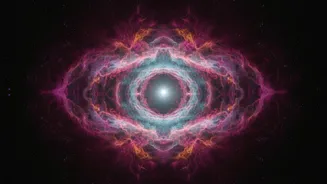
Located about 650 light-years away in the constellation Aquarius, the Helix Nebula is what’s known as a planetary nebula. The name is a bit of a misnomer left over from early astronomy; it has nothing to do with planets. Instead, it’s the beautiful, glowing
remnant of a star, much like our own Sun, that has reached the end of its life. After exhausting its nuclear fuel, the star shed its outer layers of gas into space. The tiny, super-hot core left behind, called a white dwarf, now illuminates that expanding cloud of gas, creating the spectacular structure we can observe from Earth. For astronomers, the Helix Nebula is a favorite target because it’s one of the closest examples of this process, offering a front-row seat to the final act of a star’s life.
Webb's Infrared Super-Vision
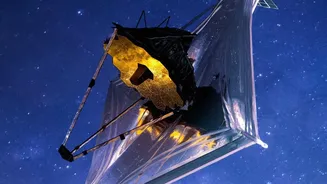
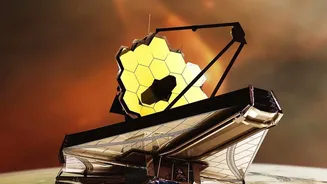
While telescopes like Hubble have captured breathtaking images of the Helix Nebula in visible light, the James Webb Space Telescope sees the universe differently. Its Near-Infrared Camera, or NIRCam, is designed to detect longer wavelengths of light that are invisible to the human eye. This is a cosmic superpower. Infrared light can penetrate through the vast clouds of gas and dust that often obscure celestial objects, revealing the hidden structures within. Think of it like the difference between seeing a foggy landscape with your eyes versus viewing it with a thermal camera that can see the heat signatures through the mist. Webb’s view cuts through the haze, bringing previously unseen features into sharp focus and providing a much clearer picture of the nebula's complex environment.
Thousands of Mysterious 'Cometary Knots'
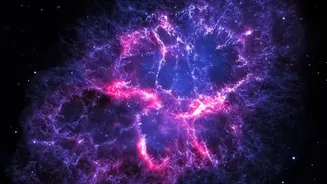
So, what did NIRCam find inside the nebula's shell? Thousands of previously unseen, tadpole-shaped objects that scientists have dubbed “cometary knots.” While these structures have been observed before, Webb’s clarity and infrared sensitivity bring them to the forefront in unprecedented detail. Each knot consists of a dense, glowing head and a long, streaming tail pointing away from the central star. They are enormous, with heads twice the size of our solar system and tails stretching for billions of miles. These knots are formed as blistering, fast-moving stellar winds from the white dwarf crash into cooler, denser gas that the star ejected thousands of years earlier. This collision fragments the material into these smaller, comet-like droplets, which are now being slowly eroded by the intense radiation from the central star.
A Postcard from Our Own Future
Beyond the sheer beauty, these new images are scientifically profound because they offer a preview of our own solar system's distant fate. In about five billion years, our Sun will also run out of fuel, expand, and shed its outer layers to form its own planetary nebula. Studying the intricate structures within the Helix Nebula is like performing a cosmic autopsy on a star like our Sun, allowing scientists to understand how stellar material is recycled back into the galaxy. This process is essential for cosmic evolution. The elements forged inside the dying star are cast out into space, enriching the interstellar medium and providing the raw materials for the next generation of stars and, potentially, planets. Every detail Webb uncovers helps piece together the epic life cycle of stars and our own place within it.