



The Foundation: Hands on Hips
For those new to Tree Pose or anyone feeling a bit wobbly, placing your hands firmly on your hips is the perfect starting point. This variation allows you to keep your awareness on your lower body, focusing on rooting down through your standing leg and maintaining
level hips. It provides a sense of stability without adding the extra challenge of coordinating the upper body. By physically touching your hips, you receive direct feedback about their alignment, ensuring they remain square to the front. This is an excellent way to build a strong and confident foundation before progressing to more complex variations.
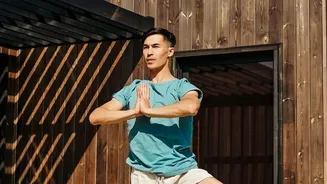
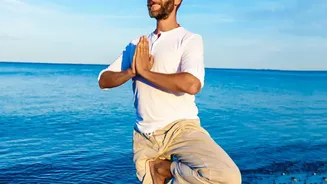
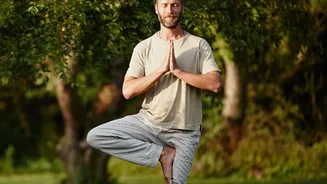
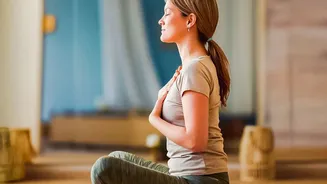
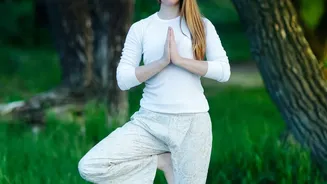
The Center: Anjali Mudra (Hands at Heart)
This is the classic and most recognized version of Tree Pose. Bringing the palms together at the heart center in Anjali Mudra helps to draw your energy and focus inward. It creates a sense of balance and equilibrium, both physically and mentally. While more challenging than hands on hips, keeping your hands at your body's midline provides a stable center of gravity. This position encourages a tall spine and open chest, fostering a feeling of calm and reverence. It’s a powerful way to connect with your breath and find stillness within the pose, making it a favorite in many yoga classes.
The Expression: Arms Like Branches
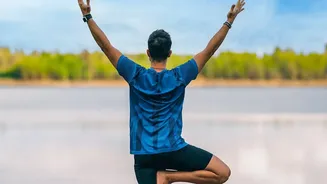
To gently increase the difficulty, try extending your arms out to the sides, parallel to the floor, like the branches of a tree. This variation immediately widens your frame and begins to challenge your stability. You can play with this position by turning the palms up to feel more energized or down for a more grounding effect. For an added layer of challenge that mimics a tree in the breeze, you can even introduce slow, flowing movements in the arms. This dynamic variation forces your core and standing leg to make constant micro-adjustments, significantly improving your proprioception, or your body's awareness of its position in space.
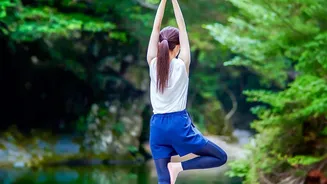
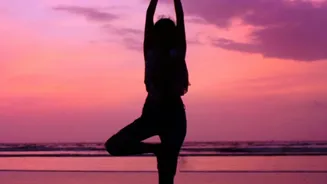
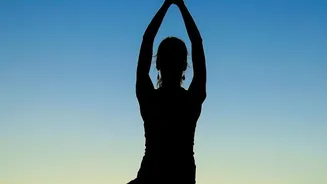
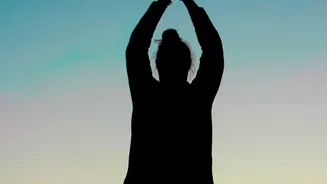
The Growth: Arms Raised Overhead
Raising your arms overhead is a significant step up in difficulty. By lifting your arms, you raise your body's center of gravity, which demands much more work from your standing leg and core to maintain balance. You can keep the palms facing each other in a 'V' shape or press them together. This variation not only challenges your stability but also provides a wonderful stretch for the shoulders and sides of the body, lengthening the entire spine from your rooted foot to your fingertips. It embodies the full expression of the pose, symbolizing growth and reaching for the sky.
The Twist: An Added Rotation
For a complex variation that tests balance and spinal mobility, you can introduce a twist. Begin in a stable Tree Pose, perhaps with hands at the heart. Keeping your hips facing forward, slowly begin to twist your upper body toward the side of your bent knee. This adds a completely new element of challenge, as your body must work to maintain balance while rotating. It deeply engages the oblique muscles and enhances spinal flexibility. This variation asks for deep concentration, connecting the grounding energy of the legs with the rotating freedom of the upper body.
The Ultimate Test: Closing Your Eyes
For the most advanced challenge, try closing your eyes in any of the arm variations. Our sense of balance relies heavily on visual cues, so when you take away your sight, you force your body to depend entirely on its internal systems for stability. You will immediately notice your ankle, leg, and core muscles firing in overdrive to keep you upright. This is a profound practice in trust and inner awareness. It's best to try this near a wall for support, as it dramatically increases the difficulty, regardless of where your arms are placed.