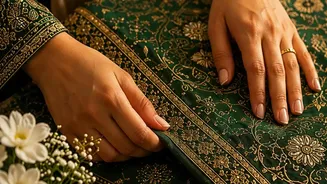







Prepare Before You Store
The first rule of saree storage is to never store a worn garment. Before you put your handloom saree away, ensure it is completely clean and dry. Even small amounts of sweat or perfume can damage the fabric over time and attract pests. After wearing,
air the saree in a shaded, well-ventilated room for a few hours to allow any moisture to evaporate completely. For fabrics like pure silk or those with heavy embellishments, it is always best to opt for a professional dry cleaner. For sturdy cotton handlooms, a gentle hand wash in cold water may be suitable, but always check the specific care instructions first.
The Art of the Fold
How you fold your saree is crucial, as incorrect folding can cause permanent creases and weaken the fabric, especially along the fold lines. For most sarees, lay it on a flat surface and fold it in half lengthwise, aligning the borders. Then, perform an accordion or pleated fold from the pallu end. A popular method is to always fold the saree with the zari work facing inwards, which protects the metallic threads from exposure to air and friction. For extremely delicate or heirloom sarees like Banarasis or Kanjivarams, textile conservators recommend rolling instead of folding. Loosely roll the saree around an acid-free tissue paper tube or a foam cylinder to prevent any creases from forming.
Choose the Right Wrapping Material
Handloom fabrics need to breathe. The most common mistake is storing sarees in plastic covers, which trap moisture and can cause the fabric to yellow, develop a musty smell, or even lead to fungal growth. The gold standard for wrapping sarees is a clean, unbleached muslin or pure cotton cloth. These breathable fabrics protect the saree from dust and friction while allowing air to circulate. Each saree should be wrapped individually to prevent colour transfer and snagging from another saree’s embroidery or zari work.
Create the Perfect Storage Environment
Where you store your sarees matters as much as how you wrap them. The ideal location is a cool, dry, and dark place, like a wooden wardrobe or a shelf. Avoid storing them near walls that might have moisture issues, such as those connected to bathrooms. While hanging is an option for lightweight sarees for short periods, heavy handlooms like silks should be stored flat. The weight of a hanging saree can stretch the fabric and distort its drape over time. Ensure you don't stack too many sarees on top of each other, as the weight can crush the delicate weaves at the bottom.
Protect Against Pests Naturally
Pests like moths and silverfish are a major threat to stored fabrics. However, it's best to avoid chemical naphthalene balls, as their fumes can react with the silver in zari, causing it to tarnish and turn black. Instead, opt for natural repellents. Dried neem leaves are a traditional and highly effective option. You can also use sachets of dried lavender, cloves, or cedarwood blocks placed in the corners of your wardrobe. These not only deter pests but also leave your sarees with a pleasant, subtle fragrance. Remember to place these repellents near the sarees, but not in direct contact with the fabric.
The Importance of Regular Maintenance
Storing sarees is not a one-time activity. To prevent permanent creases from setting in, it is essential to take your sarees out every few months and refold them along different lines. This simple habit is especially important for sarees with stiff zari borders, like Banarasi or Paithani sarees, as it prevents the metallic threads from breaking at the folds. This is also a good opportunity to air them out for a few hours indoors and check for any signs of damage or pests, ensuring your precious collection remains in pristine condition.