



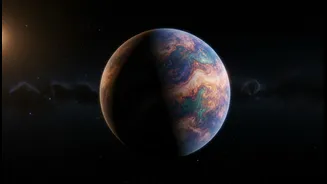
The Habitable Zone Illusion
For decades, astronomers have used the “habitable zone” as a primary filter in the search for life beyond Earth. It’s a compellingly simple concept: the range of orbits around a star where a planet could possess liquid water on its surface, a key ingredient
for life as we know it. If a planet is too close to its star, water boils away; too far, and it freezes solid. The discovery of a planet in this temperate region often sparks excitement. But the reality is far more complex. While a planet's location is a crucial starting point, it's just one piece of an incredibly intricate puzzle. A planet can be in the perfect orbital spot and still be a hostile, lifeless rock.
A Protective Atmosphere is Key
A planet’s atmosphere is its first line of defense and its climate control system. It traps heat, shields the surface from harmful radiation, and provides the necessary chemicals for life. Venus, for example, is within the Sun’s habitable zone, but its incredibly thick, carbon-dioxide-rich atmosphere creates a runaway greenhouse effect, leading to surface temperatures hot enough to melt lead. On the other hand, a planet that is too small, like Mars, can’t gravitationally hold onto a thick atmosphere, leaving it cold and exposed to harsh solar radiation. Even the composition matters; high concentrations of gases like carbon monoxide, which can be common around certain types of stars, could be toxic to complex life.
The Power of a Magnetic Shield
Earth’s invisible force field, its magnetic field, is another non-negotiable for long-term habitability. Generated by the motion of molten iron in our planet's core, this field deflects the relentless stream of charged particles from the sun, known as the solar wind. Without this shield, the solar wind would gradually strip away a planet's atmosphere, blowing it out into space. This is what is believed to have happened to Mars, which once had a thicker atmosphere and liquid water but lost its global magnetic field billions of years ago. A planet in the perfect orbit without a robust magnetic field is essentially a sitting duck, vulnerable to having its potential for life scoured away by its own star.
The Star at the Center of it All
Not all stars are created equal when it comes to hosting life. The type and behavior of the host star are critically important. Many of the most common stars in our galaxy are red dwarfs. While they have very long lifespans, their habitable zones are much closer than for a sun-like star. This proximity exposes orbiting planets to intense bursts of X-ray and UV radiation from frequent and violent stellar flares, which can sterilize a planet’s surface and erode its atmosphere. Furthermore, planets this close are often 'tidally locked,' meaning one side always faces the star, creating a world of permanent day and permanent night with extreme temperature differences.
More Than Just Location
Beyond these major factors, a host of other planetary characteristics contribute to habitability. The planet's size and mass determine its gravity, which affects its ability to hold an atmosphere. Its geological activity, like plate tectonics and volcanism, is vital for cycling chemicals and nutrients and regulating climate over long timescales. The tilt of its axis and the shape of its orbit can dictate the severity of its seasons. A world could have too much water, becoming a 'water world' with deep oceans that might make the emergence of life more complex, or it might not have enough essential elements like carbon and nitrogen to begin with. All these elements must work in concert.