





A Minefield in the Stars
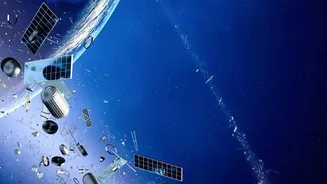
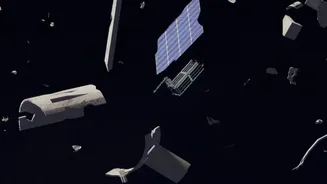
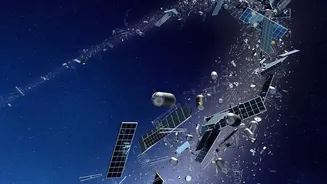
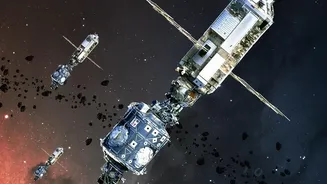
Imagine a highway with millions of tiny, untracked projectiles moving at over 28,000 kilometres per hour. That is the reality in Low Earth Orbit (LEO) today. Decades of space activity have left a cloud of debris, from defunct satellites and spent rocket
stages to minuscule paint flecks. Experts estimate there are over a million objects larger than a centimetre orbiting Earth. At such extreme velocities, a collision with an object even the size of a small marble can be catastrophic, capable of disabling or completely destroying a multi-crore satellite and creating thousands of new pieces of debris in the process. This growing threat puts critical infrastructure at risk, including satellites essential for communication, navigation, weather forecasting, and national security.
The Challenge of Manual Evasion
Until now, protecting satellites has been a labour-intensive process. Ground-based stations track known objects, and when a potential collision is flagged—a 'conjunction alert'—teams of human operators must analyse the risk, calculate a new trajectory, and command the satellite to fire its thrusters to move out of the way. This is a costly and time-consuming affair that consumes precious onboard fuel, shortening a satellite's operational lifespan. The Indian Space Research Organisation (ISRO) performed a record number of these collision avoidance manoeuvres in recent years to protect its assets, highlighting the escalating nature of the problem. With mega-constellations launching thousands of new satellites, this manual approach is rapidly becoming unsustainable.
India's AI-Powered Guardian Angels
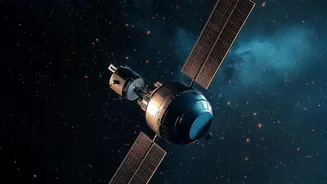
The headline technology represents a paradigm shift from manual intervention to autonomous protection. Instead of waiting for commands from Earth, the goal is to equip satellites with onboard AI that can make these life-or-death decisions independently. These intelligent systems will continuously analyse their surroundings, predict the paths of incoming debris, and automatically execute precise thruster firings to dodge threats. This not only ensures a faster reaction time but also optimises fuel consumption, extending the mission life of these valuable national assets. Indian startups are at the forefront of this innovation, developing algorithms that allow satellites to learn, adapt, and even communicate with each other to prevent collisions.
The Innovators Behind the Shield
While ISRO spearheads national efforts like Project NETRA for tracking and monitoring, a vibrant ecosystem of private Indian companies is developing the crucial hardware and software. Startups like Digantara are creating AI-powered software for Space Situational Awareness (SSA), helping to map and predict the orbital environment with greater accuracy. Others, such as Manastu Space and Bellatrix Aerospace, are building the next generation of satellite propulsion systems. Manastu has developed a 'green' propulsion system, which is not only safer but also highly efficient for the agile manoeuvres needed for collision avoidance. Bellatrix Aerospace has indigenously developed Hall-effect thrusters, the very technology used by global players like Starlink for their satellites. This combination of advanced software and hardware is creating a complete, home-grown solution.
Securing India's Future in Space
This technological leap is about more than just protecting individual satellites; it is about securing India's entire space economy and its strategic autonomy. India's growing fleet of satellites for communication, Earth observation (like the NISAR mission with NASA), and navigation (NavIC) are vital national resources. By developing autonomous collision avoidance, India is future-proofing these billion-dollar investments. It also enhances the country's reputation as a responsible spacefaring nation committed to orbital sustainability. As space becomes more congested and contested, the ability to independently protect its assets will be a cornerstone of India's ambition to be a leading power in the final frontier.