


The Old Barrier to Entry
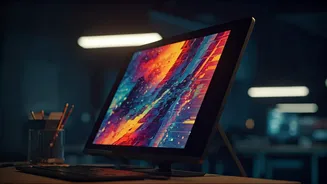
Think about what it traditionally took to create professional-looking digital art. The journey often started with mastering the fundamentals: composition, colour theory, anatomy, and perspective. Then came the technical skills—learning intricate software
like Adobe Photoshop or Illustrator, getting comfortable with a graphics tablet, and understanding layers, brushes, and rendering. This steep learning curve, combined with the cost of software and hardware, created a significant barrier. For a fresher in college or a young professional looking to explore a creative idea, the investment in time and money was often too high to justify.
Enter the AI Co-pilot
Generative AI tools like Midjourney, DALL-E 3, and Stable Diffusion have completely changed this equation. At their core, these are text-to-image models. You don't need to know how to draw; you just need to know how to describe. You type in a text prompt—a detailed description of the image you have in your mind—and the AI generates a unique, often breathtaking, visual based on your instructions. Think of it as collaborating with an infinitely fast and versatile artist who has studied nearly every image on the internet. You provide the vision, and the AI handles the technical execution in seconds.
Your Imagination is the New Skillset
This shift democratizes creativity by making the primary skill ideation, not manual dexterity. The core challenge is no longer ‘Can I draw this?’ but ‘Can I describe this effectively?’ For someone who has a brilliant visual concept but lacks the traditional artistic skills, this is incredibly empowering. You can experiment with styles, from photorealistic to anime to oil painting, simply by adding a few words to your prompt. Want to see 'a majestic elephant made of crystal, standing in a futuristic Mumbai street at sunset, in the style of a cyberpunk movie'? Previously, this would require a highly skilled artist days of work. Now, a fresher can generate multiple versions of this concept in minutes.
Practical Magic for Beginners
The applications for freshers are immediate and practical. Are you organising a college festival? Generate a unique, professional-grade logo or poster without hiring a designer. Need compelling visuals for a PowerPoint presentation or a startup pitch deck? Create custom images that perfectly match your content instead of relying on generic stock photos. You can design custom T-shirts, create stunning profile pictures, or even produce concept art for a video game idea you've been sketching out in a notebook. It lowers the barrier not just for art, but for visual communication in any field.
It’s Not a 'Cheat Code'
However, it's a mistake to think of these tools as a simple 'cheat code' that requires no effort. Getting a truly premium result isn't just about typing one sentence and getting a masterpiece. The new skill is 'prompt engineering'—learning how to write detailed, nuanced prompts to guide the AI effectively. It involves iteration and refinement. You might generate a dozen images and only find one that's usable. Often, the best results come from taking an AI-generated image and then using traditional tools like Photoshop to tweak colours, combine elements, or fix awkward details. The role of the human is shifting from pure creator to creative director, curating and refining the AI's output to match their vision.