
The Red Planet's Garden Problem
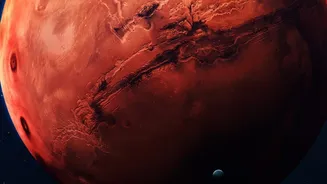
Farming on Mars is nothing like gardening on Earth. The planet is covered not in soil, but in a lifeless material called regolith. This dusty, rocky blanket is a cocktail of crushed volcanic rock, fine dust, and, most problematically, toxic salts called perchlorates
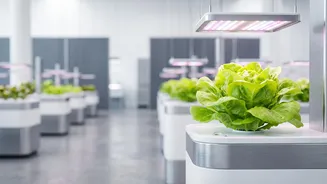
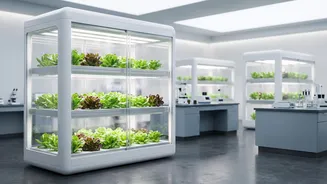
that are harmful to most plants. On top of that, Martian regolith contains almost no organic matter or the beneficial microbes that help plants thrive. Any aspiring Martian farmer also faces an environment with a thin atmosphere, intense radiation, and brutal cold. Growing crops in the open is impossible; any food production would have to happen inside pressurized, shielded greenhouses. Even then, the fundamental question remains: how do you turn toxic dust into fertile ground?
The Students Stepping Up
While space agencies like NASA and ISRO are working on this puzzle, some of the most creative solutions are coming from classrooms and university labs. Across the country, students are taking on the challenge. Recently, a team of three Texas students—Varshini Gandreddy, Dhiti Koyya, and Raaga Bukkaraju—gained recognition for their project, 'Gaia's Outpost,' at the Conrad Challenge. Their concept outlines a complete system designed to process Martian regolith, remove its toxins, and turn it into a viable medium for growing crops inside a habitat. Their work highlights a growing trend of young minds tackling problems once reserved for professional space research, contributing valuable ideas for making long-term space settlement a reality.
From Toxic Dust to Dinner Plate
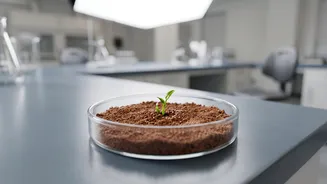
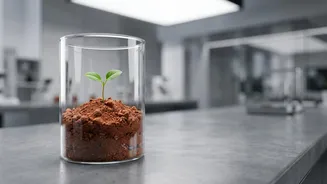
So how do you fix Martian dirt? Student projects are exploring several ingenious strategies. A team at Purdue University, working on the Plant Mars Challenge, discovered the hard way that perchlorates were killing their soybean sprouts and had to wash the simulated soil before they could get anything to grow. Other research, some led by a high school student, has shown that a hardy plant like alfalfa can be grown in the poor regolith first. Once harvested, the alfalfa can be used as a biofertilizer, enriching the regolith with the organic nutrients needed to grow more complex food crops like lettuce, radishes, and turnips. Another approach involves aquaponics, a closed-loop system where waste from fish provides the necessary fertilizer for plants, which in turn clean the water for the fish. It's a way to build a small, self-sustaining ecosystem from scratch.
First Sprouts of Hope
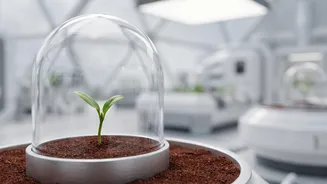
These experiments are yielding promising, if early, results. At Villanova University, a project found that sweet potatoes and various lettuces grew surprisingly well in a Martian soil simulant. Researchers at the University of Arkansas are even looking at how gene-edited rice might be resilient enough to survive the stressful conditions. Not every experiment is an immediate success. Many early attempts show stunted growth compared to plants in Earth soil. But each attempt, whether it results in a thriving plant or a valuable failure, provides critical data. Students are learning what works, what doesn't, and what amendments—from vermicompost to specific bacteria that can fix atmospheric nitrogen—are needed to make Martian farming possible.
More Than Just a Science Project
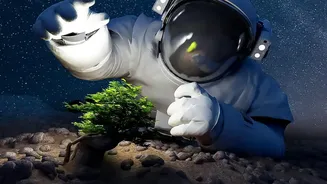
These student-led projects are about more than just finding a way to grow potatoes on another planet. They represent a fundamental shift in how we approach space exploration, proving that innovation can come from anywhere. Competitions like the Conrad Challenge and the Plant Mars Challenge empower students to engage with real-world scientific problems, fostering a new generation of scientists, engineers, and botanists. Furthermore, the solutions being developed for Mars could have applications right here on Earth, offering new techniques for farming in arid regions or on marginal lands. And for the astronauts on those future long-duration missions, a small greenhouse of fresh vegetables won't just provide vital nutrition; it will offer a psychological boost—a small, living piece of Earth billions of kilometres from home.