


The Old Problem with Physics
Physics is the language of the universe, but for decades, we’ve tried to teach it using static, two-dimensional tools. Textbooks and chalkboards are great for equations, but they often fail to convey the dynamic, three-dimensional nature of concepts like
electromagnetism, wave-particle duality, or relativity. This abstraction is a major reason why many students find the subject difficult and disconnected from reality. For schools with limited budgets, the problem is compounded by a lack of access to expensive and often delicate lab equipment, turning practical lessons into purely theoretical exercises.
Enter the Virtual Classroom
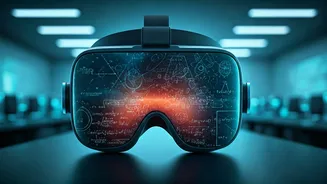
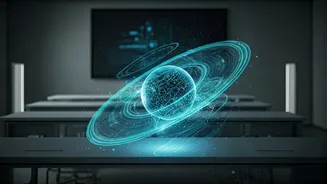
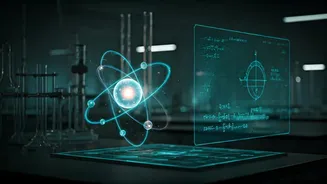
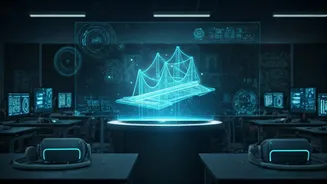
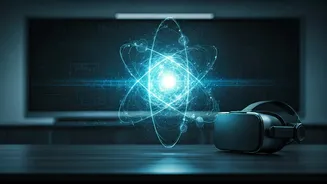
Imagine, instead, putting on a Virtual Reality (VR) headset and finding yourself standing on the surface of the moon to experience lower gravity firsthand. Or shrinking down to the size of an atom to see how electrons orbit a nucleus. This is the promise of AI-powered VR classrooms. VR provides the immersive environment, a digital world where the laws of physics are the only rules that matter. Students are no longer passive observers; they become active participants in their own learning, able to manipulate variables and see the consequences in real-time, in a safe and endlessly repeatable virtual space.
How AI and VR Work Together
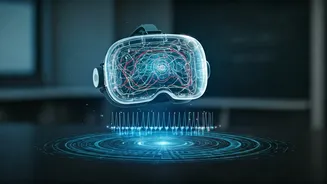
While VR provides the 'where,' Artificial Intelligence (AI) provides the 'who'—a personalised tutor for every student. The AI engine works in the background, tracking a student's performance, identifying areas where they struggle, and adapting the difficulty of the simulation accordingly. If a student is having trouble understanding projectile motion, the AI can generate new scenarios, provide visual cues, or offer hints. It can also act as a lab assistant, answering questions and guiding experiments. This synergy creates a powerful learning loop: VR makes the experience engaging, and AI makes it effective.
Making the Abstract Concrete
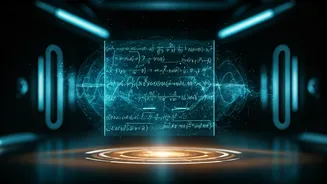
The true power of this technology lies in its ability to make abstract concepts tangible. Students can build a virtual circuit and see the flow of electrons, something impossible to observe in a real-life lab. They can visualise the warping of spacetime around a black hole, a concept that exists only in complex mathematics. They can experiment with dangerous materials or high-voltage electricity without any risk. By turning abstract equations into interactive experiences, these platforms help build intuition. Students don't just memorise Newton's laws; they feel them.
Is This the Future for India?
The potential for this technology in India is immense. It could help bridge the gap between well-resourced urban schools and their rural counterparts, giving every student access to a world-class virtual lab. Initiatives under the National Education Policy (NEP) 2020 already emphasise experiential learning and the integration of technology. While the initial cost of hardware and software remains a hurdle, prices are falling. Pilot programs are emerging in private schools and EdTech platforms are developing India-specific content. The bigger challenge will be training teachers not just to use the technology, but to integrate it effectively into their pedagogy.
The Teacher's New Role
Crucially, this technology is not about replacing teachers. It's about upgrading their toolkit. Freed from the burden of explaining the same abstract concepts repeatedly, teachers can become facilitators of discovery. They can focus on higher-order thinking, leading discussions about the 'why' behind the virtual experiments and connecting the concepts to real-world applications. In an AI VR classroom, the teacher shifts from being a 'sage on the stage' to a 'guide on the side,' mentoring students as they explore the universe's fundamental principles on their own terms.