





The UAE's Grand Tour
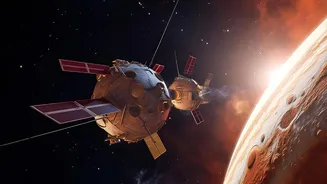
The project, called the Emirates Mission to the Asteroid Belt (EMA), is the UAE's second interplanetary mission, following its successful Hope probe to Mars. The main spacecraft, named the MBR Explorer, is scheduled to launch from Japan in March 2028.
Its goal is to perform a 'grand tour' of the main asteroid belt located between Mars and Jupiter. Over an eight-year journey, it will conduct flybys of six different asteroids before arriving at its final and most important destination in 2034: a mysterious, reddish asteroid named 269 Justitia.
India's Deep Space Connection: HEX20
At the heart of this international endeavour is HEX20, a space-tech startup with its engineering facility in Technopark, Thiruvananthapuram, and operations in the UAE. Founded by a group of Malayali engineers, HEX20 has become the first private Indian company to be selected for a deep-space mission by a Gulf nation. The company was chosen by the UAE Space Agency and the Technology Innovation Institute (TII) in November 2024 to develop critical components for the mission's asteroid probe.
Building the Brains of the Probe
HEX20 was tasked with engineering the 'spacecraft bus' for the lander probe. This isn't just a simple frame; the bus is the core structure that houses and operates the probe's scientific instruments. HEX20 developed the mission software, a robust onboard computer, and the power systems—all designed to withstand the harsh radiation and extreme temperatures of deep space for years. After HEX20 delivered its systems in just 15 months, the final probe was assembled in Abu Dhabi by a collaborative team including TII and the UAE Space Agency. This probe is the only deployable payload on the MBR Explorer, designed to operate fully autonomously once it separates from the main craft.
A Seven-Stop Asteroid Itinerary
The mission's path is a masterclass in orbital mechanics, using gravity assists from Venus, Earth, and Mars to slingshot the MBR Explorer across the solar system. The flyby targets are 10253 Westerwald, 623 Chimaera, 13294 Rockox, 88055 Ghaf, 23871 Ousha, and 59980 Moza. These encounters will provide valuable data on a diverse range of asteroid types. But the main event is the rendezvous with 269 Justitia. The MBR Explorer will orbit this asteroid for seven months before the HEX20-enabled probe is released.
The Final Target: Red and Mysterious
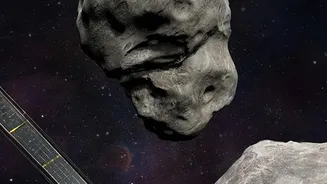
The probe will then descend to the surface of 269 Justitia, a process expected to take a few hours, capturing images all the way down. While the mission plan refers to it as a 'landing', engineers don't expect the probe to survive the impact. If it does, a battery could allow it to send back data from the surface for a short time. Justitia is a particularly fascinating target because its unusually red surface suggests it may contain complex organic materials. Scientists theorise it may have originated in the distant Kuiper Belt beyond Neptune before migrating inwards, and studying it could offer clues about the origins of life and water in our solar system.