




A Galaxy Like No Other
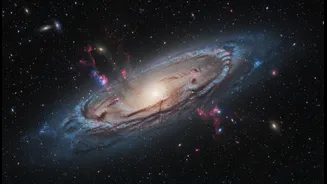
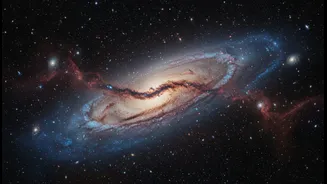
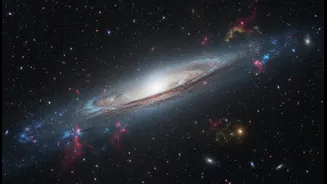
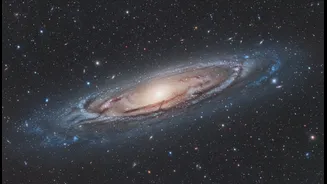
To mark four years of groundbreaking science, NASA has released an astonishingly detailed image of Centaurus A. Located a relatively close 11 million light-years from Earth, Centaurus A is not a quiet, settled galaxy. It’s what is known as an active galaxy,
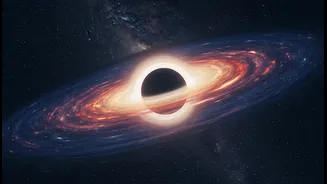
shaped by a dramatic past and a turbulent present. At its heart lies a supermassive black hole that is actively consuming surrounding gas and dust, launching powerful jets of energy that sculpt the galaxy around it. This constant activity makes it a perfect natural laboratory for understanding how galaxies and their central black holes grow and evolve together.
Peering Through the Dust
What makes this new image so special is Webb’s ability to see in infrared light. Previous attempts to study Centaurus A’s core with telescopes like Hubble were blocked by thick lanes of cosmic dust. While NASA's retired Spitzer Space Telescope could see in infrared, it couldn't resolve the fine details. Webb’s powerful instruments, MIRI (Mid-Infrared Instrument) and NIRCam (Near-Infrared Camera), cut through the dust to reveal a dense, glittering tapestry of millions of individual stars. For the first time, scientists can see the galaxy's inner workings star by star.
Uncovering a Violent Past
Centaurus A’s unusual structure is the result of a colossal cosmic event: a collision with another galaxy that happened about two billion years ago. The aftermath of this merger is still visible in its warped shape and intense pockets of star formation. Webb’s new images reveal these star-forming regions—where old stars are shedding material and new ones are being born—with stunning clarity. The glowing, dusty structures, some in unusual shapes like a parallelogram and a strange 'S' curve, provide astronomers with a vivid record of the galaxy's chaotic history, almost like a form of galactic archaeology.
More Than Just a Pretty Picture
Webb’s capabilities extend far beyond taking beautiful images. By using a technique called spectroscopy, astronomers can analyze the light to understand how gas moves within the galaxy. Early findings from this new data show fast-moving gas flowing outward from the black hole's activity, alongside a warped, rotating disk of warmer hydrogen gas near the center. This helps scientists investigate one of the biggest questions in astronomy: how does a supermassive black hole influence an entire galaxy? The data suggests the relationship is complex, with the black hole both triggering star birth by compressing gas and halting it by pushing material away.
A New Era of Discovery
These new observations of Centaurus A are a testament to how far astronomy has come. Since its first images were released in July 2022, the James Webb Space Telescope has consistently delivered discoveries that have changed our understanding of the cosmos. From the earliest galaxies forming after the Big Bang to the atmospheres of planets orbiting other stars, Webb continues to open new windows on the universe. The telescope has become our foremost eye on the sky, building on the legacy of observatories like Hubble and Spitzer to push the boundaries of human knowledge.