



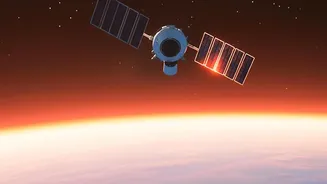
An Unblinking Eye at Lagrange Point 1
To truly understand the Sun, you need to watch it constantly. That's the core idea behind Aditya L1's strategic placement. The spacecraft is positioned in a halo orbit around Lagrange Point 1 (L1), a spot 1.5 million kilometres from Earth. From this unique
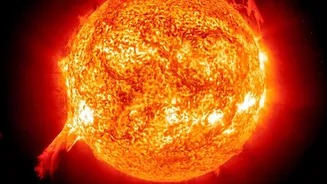
vantage point, it has an uninterrupted, 24/7 view of the Sun, free from the eclipses or occultations that would block its vision from an Earth orbit. This continuous stream of observation is critical. Solar events like Coronal Mass Ejections (CMEs) — massive eruptions of plasma and magnetic fields — can develop and race towards Earth in hours. By stationing Aditya L1 at this upstream location, the Indian Space Research Organisation (ISRO) gets a crucial head start, observing solar activity and space weather before it reaches our planet.
From Guesswork to Precision Forecasting
Before Aditya L1, predicting space weather was a significant challenge. While ground-based and other space observatories provided valuable data, there were gaps in our understanding of the Sun's behaviour. Aditya L1 is designed to fill these gaps. Its suite of instruments provides a more complete picture of solar events, from their origin in the Sun's atmosphere to their journey through space. For example, recent studies using Aditya L1 data investigated a powerful solar storm, revealing that the most severe effects on Earth's magnetic shield occurred during the impact of the storm's turbulent region. The ability to identify such features with Aditya L1's help is a leap forward. It allows scientists to move from broad warnings to more specific, actionable intelligence about a storm's potential impact, helping to safeguard critical satellite and communication infrastructure.
The Seven Instruments Changing the Game
Aditya L1 carries seven sophisticated payloads, four for remote sensing of the Sun and three for in-situ measurements of the local environment. This combination is what makes the mission so powerful. Instruments like the Visible Emission Line Coronagraph (VELC) and the Solar Ultraviolet Imaging Telescope (SUIT) are providing unprecedented views of the Sun's corona and chromosphere. SUIT, for instance, has opened a new window into solar physics by capturing the first-ever images of the Sun in crucial near and mid-ultraviolet wavelengths. Meanwhile, other instruments have directly measured the characteristics of solar wind and magnetic fields. In one breakthrough finding, data from VELC helped scientists get closer to solving the 'coronal heating problem'—why the Sun's atmosphere is millions of degrees hotter than its surface. The data suggests magnetic field reconfiguration is the primary cause, a discovery that fundamentally improves solar models.
Why Solar Predictions Matter for India
In an increasingly digital India, our reliance on technology makes us vulnerable to space weather. A severe solar storm could disrupt everything from banking systems and online services to navigation systems like GPS and NaVIC, which are vital for transportation and defence. It could also threaten the stability of our national power grids. By developing the capability to issue more accurate and timely space weather alerts, the Aditya L1 mission serves as a crucial shield for India's technological backbone. The data gathered is not just for academic pursuit; it has profound national and societal relevance. ISRO has already begun releasing science-ready data to the global research community, cementing India's role as a key player in heliophysics and space science. This initiative is seen as a crucial milestone for developing India's own comprehensive space weather prediction program.