
A Storm Inside a Storm
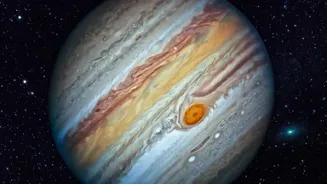
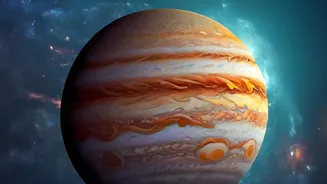
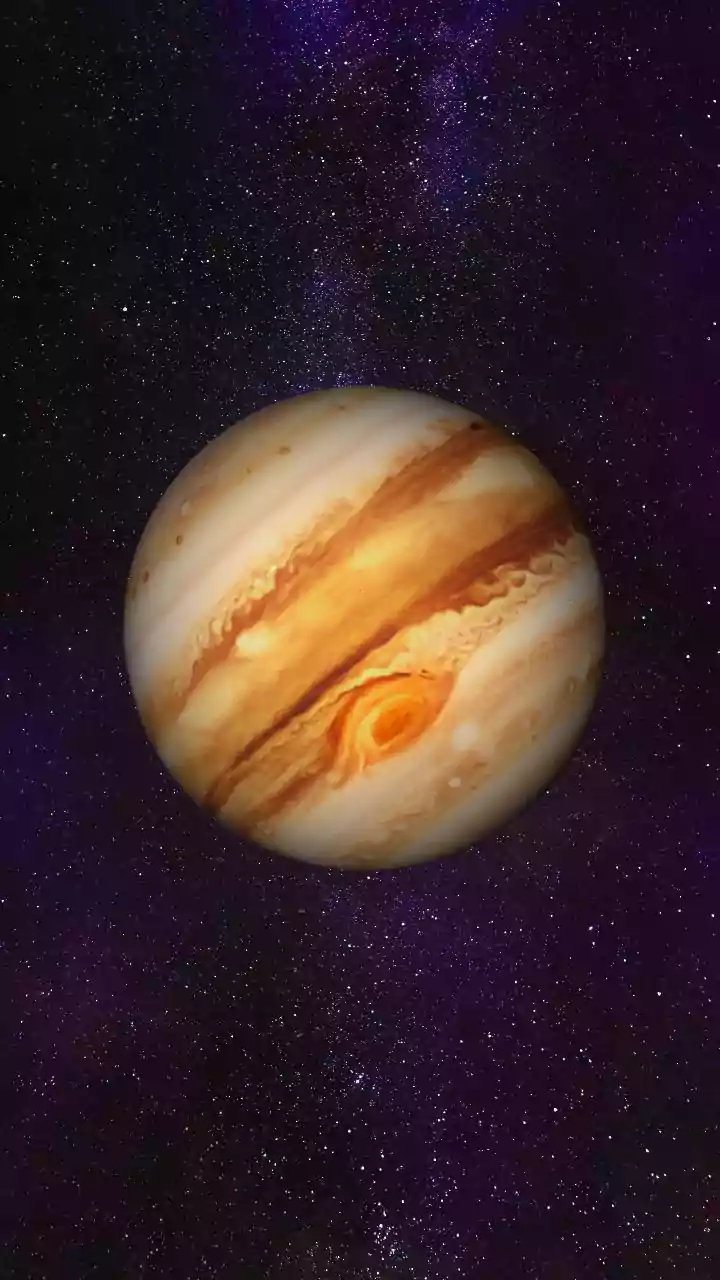
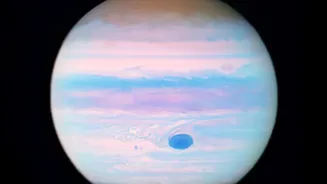
For at least 150 years, and perhaps much longer, astronomers have tracked the Great Red Spot, a vast high-pressure system known as an anticyclone. It’s a permanent feature in Jupiter’s turbulent atmosphere, wedged between powerful jet streams. But the term
“Red Spot” is a bit of a simplification. Within this colossal storm are smaller, rotating structures, which the headline describes as “cosmic tornados.” In scientific terms, these are vortices or eddies. For years, scientists have hypothesized that these smaller eddies feed into the main storm, acting as a source of energy that helps sustain the Great Red Spot. Think of them as smaller whirlpools being drawn into a much larger one, transferring their momentum and keeping the whole system spinning.
New Eyes on an Old Giant
The latest insights come from advanced observatories like the Hubble Space Telescope and the James Webb Space Telescope (JWST). These powerful instruments can see the gas giant in wavelengths of light, including infrared, that are invisible to the human eye. This allows them to peer through the hazy upper layers of Jupiter's atmosphere and capture unprecedented details. Recent studies, some using data collected over the last couple of years, have provided the clearest views yet of the structures and dynamics within and above the Great Red Spot. Astronomers were surprised to find a region once thought to be unremarkable was actually full of intricate structures. These new, high-resolution time-lapse observations allow scientists to track the motion and behaviour of the storm with incredible precision.
The Shrinking Storms
The headline's claim of “shrinking cosmic tornados” points to a fascinating and complex process. The Great Red Spot itself has been shrinking for decades. In the late 1800s, it was wide enough to fit three Earths inside; today, it’s just over one Earth-width across. The rate of shrinkage has even appeared to accelerate at times. One leading hypothesis for this overall downsizing is a change in its diet. Recent modeling suggests that the Great Red Spot may be shrinking because it is being “starved” of the smaller storms it usually consumes to sustain itself. The new captures allow scientists to watch this process in action, observing how these smaller eddies interact with the main vortex and, in some cases, dissipate or get torn apart, potentially sapping the storm of its energy instead of feeding it.
Why This Cosmic Weather Report Matters
Studying the dynamics of the Great Red Spot is more than just planetary sightseeing. Jupiter’s atmosphere is a massive natural laboratory for fluid dynamics, the study of how liquids and gases move. The rules that govern Jupiter’s storms are the same ones that govern weather on Earth, just at an almost unimaginable scale and without the influence of land or oceans. By understanding what makes the Great Red Spot tick—and what might be causing it to change—scientists can refine their models of atmospheric physics. This knowledge not only helps us understand the past and future of our own solar system's planets but also provides crucial context for studying the atmospheres of exoplanets orbiting distant stars. Every new detail, like a wobbling motion recently detected by Hubble, adds another piece to the puzzle of how these giant storms work.