

The Sun’s Invisible Breath
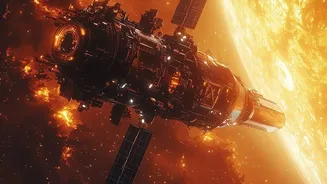
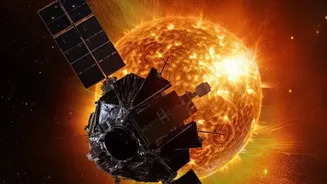
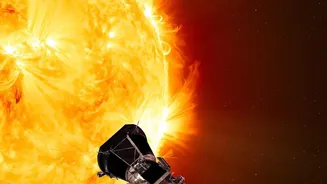
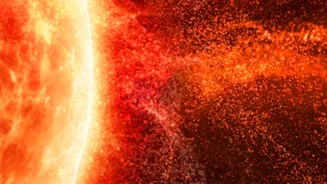
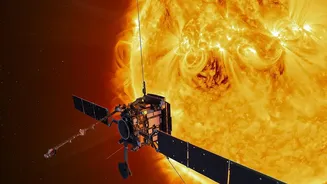
The Sun continuously emits a stream of charged particles—mostly electrons and protons—known as the solar wind. This wind travels at supersonic speeds, typically between 300 and 750 kilometres per second. While usually benign, the Sun can also unleash
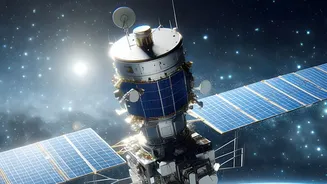
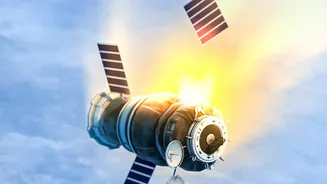
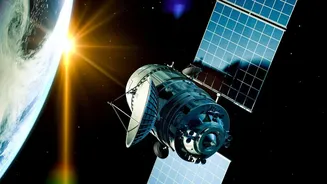
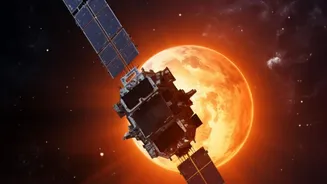
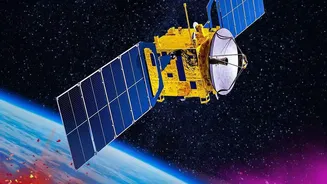
more violent outbursts called Coronal Mass Ejections (CMEs). These are massive eruptions of plasma and magnetic fields that can significantly intensify the solar wind. When these solar storms hit Earth, they can wreak havoc on our space-based technology. The influx of energetic particles can damage satellite electronics, cause internal charging that leads to malfunctions, and heat the upper atmosphere, increasing drag on satellites and causing their orbits to decay. This puts the communication, navigation, and broadcasting services we rely on daily at serious risk.
Seeing the Unseeable from Earth
While spacecraft can measure the solar wind directly, they only provide data at a single point in the vastness of space. To get a bigger picture, scientists turn to a clever ground-based technique called Interplanetary Scintillation (IPS). This method doesn't look at the solar wind itself, but rather at how it affects radio waves from very distant cosmic objects. Observatories like the Ooty Radio Telescope (ORT) in Tamil Nadu, a facility designed and built with Indian resources, are pioneers in using this technique. By observing these flickers, scientists can effectively create a forecast for space weather heading our way.
A Cosmic Twinkle
Interplanetary Scintillation is similar to the twinkling of stars in the night sky. A star twinkles because its light is distorted by turbulence in Earth's atmosphere. IPS works on the same principle, but on a much grander scale. Ground-based radio telescopes focus on distant, compact radio sources like quasars. As the radio waves from these quasars travel through the solar system, they pass through the solar wind. The dense, turbulent clouds of plasma in the solar wind scatter and distort these radio waves, causing their intensity to fluctuate, or 'scintillate', by the time they reach Earth. Denser, faster-moving patches of solar wind cause more intense scintillation.
From Twinkles to Tomography
A single telescope can detect these scintillations, but to measure velocity, you need a network. By using multiple radio telescopes located hundreds of kilometres apart, such as the network operated by Nagoya University in Japan, scientists can observe the same radio source simultaneously. The scintillation pattern will arrive at one telescope slightly before the other. This time lag reveals how fast the solar wind plasma is moving across the line of sight. By taking many such observations from hundreds of different radio sources, researchers can build up a three-dimensional tomographic map of the solar wind's speed and density throughout the inner heliosphere. This gives a global view that complements single-point spacecraft measurements.
Safeguarding Our Digital World
These ground-based measurements form the backbone of space weather forecasting. Centres like India's Regional Warning Centre (RWC India) collect solar and geophysical data to issue daily forecasts and warnings. When observatories detect a fast-moving CME hurtling towards Earth, they can provide a crucial one- to two-day warning. This allows satellite operators to take protective measures. They might power down sensitive electronics, reorient the spacecraft to protect critical components, or postpone delicate orbital maneuvers. These actions prevent permanent damage and ensure the continuity of services, from GPS navigation that guides our transport to the satellite links that enable global financial transactions and communications.